- Language
Cat6 FTP Cable vs UTP Cable: Which Is Easier to Install for Home Wiring
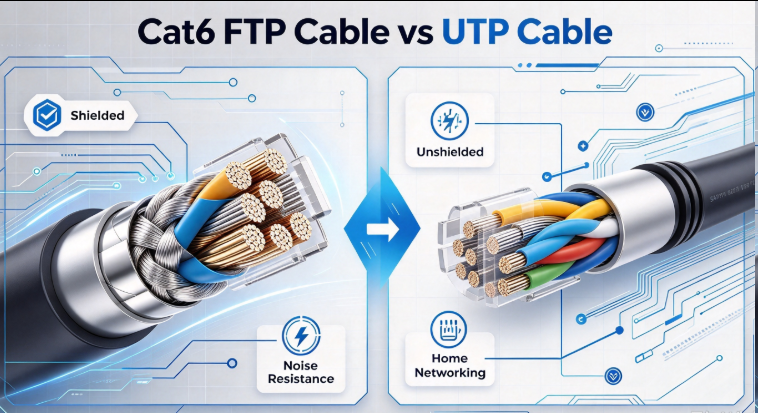
When undertaking whole-house network wiring projects, homeowners and electricians frequently compare Cat6 FTP (Foiled Twisted Pair) and UTP (Unshielded Twisted Pair) cables to determine the most install-friendly option, with Cat6 UTP emerging as the simpler, more cost-effective choice for standard residential applications. Cat6 UTP cables feature a basic twisted-pair structure without any metal shielding layers or outer foil wrapping, consisting solely of insulated copper wire pairs and a flexible PVC outer sheath. This simplified structural design significantly reduces cable weight and hardness, making UTP cables highly flexible and easy to bend, route, and manipulate during installation. In contrast, Cat6 FTP cables incorporate a full aluminum foil shielding layer wrapping all twisted wire pairs, plus additional grounding wires, which increases cable thickness, stiffness, and overall weight, bringing greater challenges for on-site wiring operations.
The installation difficulty gap between Cat6 UTP and FTP cables is most prominent in complex home wiring scenarios such as wall cavity routing, corner bending, and conduit threading. Cat6 UTP cables support small-radius bending without signal performance loss, allowing installers to navigate tight wall corners, narrow conduit passages, and compact ceiling spaces effortlessly. The lightweight and pliable nature of UTP cables also reduces labor fatigue during long-distance whole-house wiring, accelerating construction progress and lowering the risk of cable skin damage caused by forced bending. Meanwhile, UTP cables require no grounding treatment during installation, eliminating the extra steps of stripping shielding layers, connecting grounding wires, and testing grounding continuity that are mandatory for FTP cables. This streamlined installation process makes UTP ideal for DIY home wiring and general residential construction teams with limited professional shielding wiring experience.
While Cat6 UTP is easier to install, the selection between UTP and FTP should balance installation convenience and actual usage environment requirements. Cat6 UTP delivers stable gigabit network performance in standard residential spaces with low electromagnetic interference, fully meeting daily needs for internet browsing, video streaming, and smart device networking. Cat6 FTP, though more difficult to install, provides superior anti-electromagnetic interference capabilities, making it suitable for special environments near high-power electrical equipment, industrial areas, or dense power line layouts. For ordinary home users pursuing simple, fast, and low-cost wiring, Cat6 UTP is the optimal choice; for high-interference scenarios requiring ultra-stable network signals, the extra installation effort of Cat6 FTP is worthwhile for long-term signal reliability.
Read recommendations:
Factory Price Toolless RJ45 UTP Cat6 Keystone Jack
LEG 77118 Mosaic Socket French Std 2P+E Automatic Terminals Surface Red
-

-

-

-

-

-

-

-

-

-

Office Printer Network Patch Cord 6
Nov 24, 20262069
-

Dustproof Cover Equipped Network Patch Panel
Oct 10, 20261117
-

How to wire a French switch outlet
Oct 28, 20261112
-

Network Cable Break Point Detector Tester
Oct 09, 20261089
-

Cat6 Lan Cable Length Limit for Gigabit
Oct 24, 20261086