- Language
Cat6 LAN Cable Maximum Distance Before Signal Loss
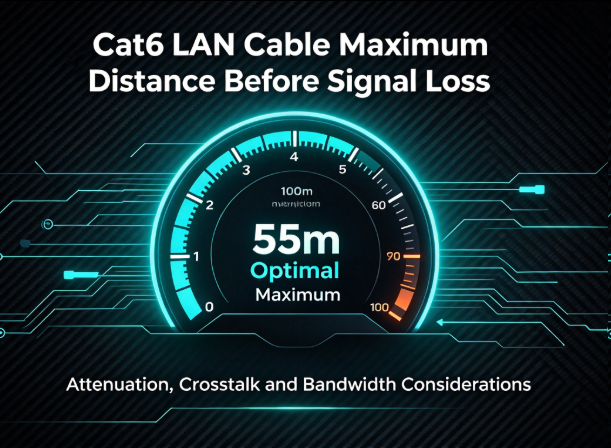
Cat6 Ethernet cable is one of the most widely used twisted-pair networking cables for residential, commercial, and light industrial networking, with standardized performance metrics defined by the TIA/EIA 568-C.2 industry standard. The maximum effective transmission distance of Cat6 cables before significant signal loss occurs is primarily determined by bandwidth frequency, signal attenuation, and crosstalk interference, with a core rated distance of 100 meters (328 feet) for standard stable operation. Within the 100-meter range, Cat6 cables maintain a maximum bandwidth of 250 MHz and support data transfer speeds up to 10 Gbps, which fully covers the requirements of gigabit Ethernet and 10-gigabit mainstream network environments. This 100-meter limit is a universal industry specification that accounts for cumulative signal degradation caused by cable resistance, electromagnetic interference, and line capacitance during long-distance transmission.
It is critical to distinguish between stable working distance and marginal signal loss distance for Cat6 cables. When the cable length exceeds 100 meters but stays within 150 meters, basic network connectivity may still be available, but obvious signal attenuation, increased packet loss rate, reduced transmission speed, and higher network latency will occur. In this over-range state, 10 Gbps high-speed transmission is completely unavailable, and the network may even drop to 100 Mbps low-speed mode or experience frequent disconnections. For lengths beyond 150 meters, the signal loss is irreversible, and effective data transmission cannot be guaranteed at all. Unlike lower-grade Cat5e cables that suffer severe signal degradation over long distances, Cat6 cables feature improved twisted pair spacing and insulation materials, which optimize anti-interference performance and delay signal loss, but they cannot break through the physical limit of twisted-pair transmission.
In practical networking projects, many factors will affect the actual signal loss distance of Cat6 cables. High-temperature environments, bundled dense cable layouts, and proximity to high-power electrical equipment will enhance electromagnetic interference, accelerating signal attenuation and reducing the effective transmission distance by 10 to 20 meters. In contrast, open, low-interference indoor environments can maintain the standard 100-meter stable transmission. For long-distance networking exceeding 100 meters, network switches, signal repeaters, or fiber optic cable extensions must be used to amplify and regenerate signals to compensate for line loss. Overall, the 100-meter standard distance is the absolute safe threshold for Cat6 cables to exert full performance, and any extension beyond this range will inevitably sacrifice network stability and transmission efficiency.
Read recommendations:
JACK C6 180 Degree Rotary Type, cat6 Toolless keystone jack
LEG 77010 French Type Mosaic Energy Saving Switch 1 Way Switch 10AX (2 modules) White
New Smart Touch Control Faceplate Wifi Smart Swith Socket for Home Or Hotel System
-

-

-

-

-

-

-

-

-

-

Dustproof Cover Equipped Network Patch Panel
Oct 10, 20261117
-

How to wire a French switch outlet
Oct 28, 20261112
-

Network Cable Break Point Detector Tester
Oct 09, 20261089
-

Cat6 Lan Cable Length Limit for Gigabit
Oct 24, 20261085
-
RJ45 Connector Cat6 for DIY Cable Making
Nov 20, 20261032