- Language
Cat6 Patch Codes for Cable Identification
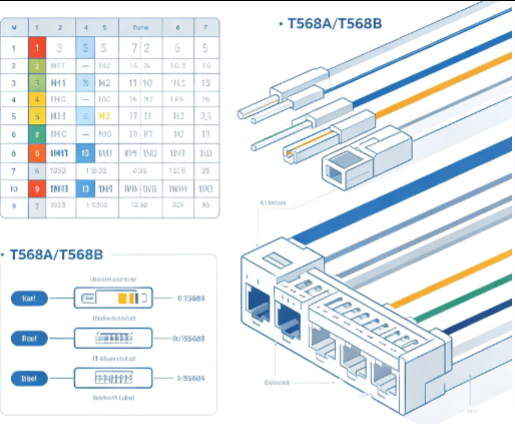
Cat6 patch cable identification codes are standardized marking and coding systems customized for network cable differentiation, management, and traceability, serving as a core auxiliary tool for refined network cable management in medium and large-scale network systems. Different from color coding that relies on visual distinction, patch identification codes adopt digital, alphabetic, or combined coding rules to uniquely mark each Cat6 patch cable link, realizing precise positioning, attribute recording, and whole-life cycle management of network cables. This coding system is widely used in enterprise office networks, school campus networks, hospital information systems, and data center infrastructure, effectively solving the problems of indistinguishable cable links, unclear connection relationships, and difficult fault tracing in complex wiring environments.
The compilation of Cat6 patch identification codes follows unified industry and enterprise internal specifications, with flexible coding forms adapting to different network management scales. The most commonly used coding mode is regional + equipment + serial number combination coding: the first segment represents the network deployment area, such as office floor, equipment room number, and building number; the second segment represents connected equipment types, including switches, servers, desktop terminals, and wireless APs; the last segment is the independent serial number of the cable, ensuring that each patch cable has a unique identity code. In addition, functional coding can be added to mark link attributes, such as trunk link, user terminal link, backup link, and dedicated service link. All codes are printed or pasted on both ends of Cat6 patch cables to ensure consistent identification at both plug ends, facilitating two-way line checking and positioning.
The application of Cat6 patch identification codes greatly improves the standardization and efficiency of network management. For network maintenance personnel, when network faults such as disconnection, lag, and packet loss occur, they can quickly locate the faulty cable, check the corresponding connection equipment and link purpose through the unique code, and complete fault elimination in the shortest time, avoiding large-scale line troubleshooting. For network system expansion and renovation, coded patch cables can clearly reflect the existing network layout and link resource usage, helping engineers formulate reasonable expansion plans and avoid repeated wiring and resource waste. Meanwhile, standardized coding management realizes the file-based recording of all Cat6 patch cable links, forming complete network asset information, which is convenient for enterprise asset statistics, daily inspection, and later maintenance. In large-scale network systems with thousands of cable links, scientific patch cable identification coding is an essential foundation to ensure stable, orderly, and manageable network operation.
Read recommendations:
LEG 77252 Multi-support Double Socket Mosaic - 2 x 2P+E Automatic Terminals German Standard White
India South Africa TuYa 10A smart plug
-

-

-

-

-

-

-

-

-

-

Dustproof Cover Equipped Network Patch Panel
Oct 10, 20261117
-

How to wire a French switch outlet
Oct 28, 20261112
-

Network Cable Break Point Detector Tester
Oct 09, 20261089
-

Cat6 Lan Cable Length Limit for Gigabit
Oct 24, 20261085
-
RJ45 Connector Cat6 for DIY Cable Making
Nov 20, 20261032