- Language
Analysis of Precision Manufacturing Process and Accuracy Control Points of 3ft CAT7 Patch Cables from a Process Perspective
The 3-foot (3ft) CAT7 patch cable is a mainstream wire for short-distance interconnection in computer room cabinets, equipment desktops and weak current terminals. Compared with conventional long-distance network cables, short-size patch cables impose stricter requirements on processing technology, structural accuracy and assembly consistency. There is no redundant transmission buffer space in short-distance wiring scenarios, and subtle process flaws, structural deviations and assembly errors will directly cause excessive crosstalk, impedance offset, abnormal signal attenuation and other problems, seriously affecting the stability of 10-gigabit transmission. From the perspective of manufacturing technology, the core production of 3ft CAT7 patch cables lies not in lengthening the wire manufacturing process, but in the standardized structure, complete shielding integrity, precise termination accuracy and mechanical stability control under short-size conditions. Every refined manufacturing process directly determines the electrical performance and long-term service reliability of finished products. This article disassembles the core manufacturing difficulties, precise process standards and quality control logic of 3ft CAT7 patch cables from the perspective of the whole-process manufacturing technology.
The basic conductor and insulation process is the underlying core to ensure the transmission performance of short-length patch cables. CAT7 patch cables uniformly adopt stranded oxygen-free copper conductors. Different from solid single-strand wires, the stranded structure features higher flexibility, adapts to frequent bending and plugging in short-distance scenarios, and effectively avoids core fracture and signal interruption. In the basic extrusion process, high-precision extrusion molds are adopted in the production line to strictly control the insulation thickness, concentricity and outer diameter tolerance, eliminating process defects such as insulation eccentricity and uneven thickness. For 3ft short-length wires, the effective transmission path is concentrated, and tiny deviations in the insulation layer will cause local impedance fluctuations. Therefore, the process adopts constant-speed extrusion and constant-temperature cooling throughout the whole process to accurately control the cooling rate, preventing surface stress cracks caused by excessive fast cooling and sheath deformation caused by excessive slow cooling. It ensures highly unified electrical parameters for each short-length wire section and lays a uniform and stable physical foundation for 600MHz high-frequency bandwidth transmission.
Differential pair twisting and cabling technology is the core process difficulty of CAT7 short-length patch cables and a key difference from ordinary network cables. Network transmission crosstalk mainly originates from electromagnetic coupling between wire pairs. The CAT7 standard requires four twisted pairs to adopt a differentiated pitch twisting process, with independently set twisting pitch, back-twist rate and tension parameters for each wire pair to accurately offset near-end and far-end crosstalk. Conventional long cables can weaken local errors through length homogenization, while defects such as pitch disorder, uneven tension and unbalanced twisting density will be infinitely amplified in 3ft short-length patch cables with extremely short effective transmission length. Therefore, in the manufacturing process, the equipment adopts a fully automatic closed-loop tension control system to maintain constant twisting tension throughout the process, eliminating loose twisting, tight twisting and misalignment defects. Meanwhile, it strictly controls the cabling pitch and take-up speed to ensure regular structure, uniform roundness and constant relative position of wire pairs for the entire short cable, suppress high-frequency crosstalk from the root of the process, and guarantee lossless and delay-free stable 10-gigabit transmission.
Shielding forming and short-length cutting processes directly determine the anti-interference integrity of patch cables. CAT7 series patch cables achieve high-frequency anti-interference performance through sophisticated shielding structures. In the manufacturing process, each wire pair is first wrapped with independent aluminum foil shielding, ensuring full coverage, no wrinkles, no damage and no missing wrapping, perfectly fitting the core structure and eliminating local shielding gaps. The outer high-density braided mesh adopts a precision weaving process with strictly controlled weaving density and coverage, forming a complete shielding loop with drain wires. In the 3ft fixed-length cutting process, the key technological points are accurate fixed-size cutting and flush trimming, while avoiding shielding layer tearing, core offset and aluminum foil warping at the moment of cutting. Short-length wires are shaped and fixed immediately after cutting to prevent loose shielding layers and wire pair misalignment, ensuring consistent and complete shielding structure at both ends of the short patch cable and avoiding shielding failure and electromagnetic leakage caused by short-size processing, which adapts to high electromagnetic interference scenarios such as computer rooms and industrial control systems.
Outer sheath forming and shaping processes focus on the durability and structural stability of short-length patch cables. The sheath is extruded with environmentally friendly flame-retardant PVC or low-smoke zero-halogen (LSZH) materials for multi-scene indoor application. The process accurately controls the sheath thickness and coating uniformity with a smooth surface free of bubbles, scratches and uneven points. Aiming at the service characteristics of frequent plugging and concentrated bending of 3ft short patch cables, an additional shaping process is added in the manufacturing process to optimize the flexibility and bending resistance of the wires, avoiding hardening and cracking caused by stress concentration of short-length wires. Meanwhile, the straightness of short-length wires is uniformly controlled to prevent bending, deformation and twisting, ensuring regular appearance and stable structure of finished products, adapting to narrow-space cabinet wiring and neat desktop wiring scenarios, and balancing practicality and aesthetics.
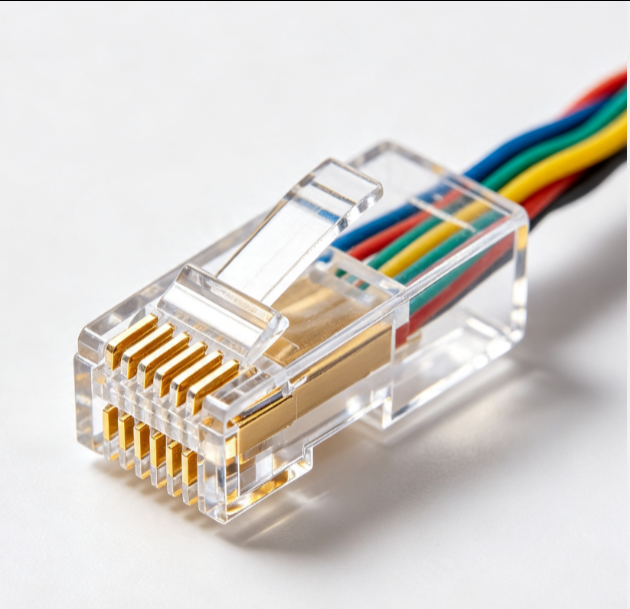
Terminal crimping and wire sequence calibration are the core terminal processes of short-length CAT7 patch cables. The patch cables strictly follow the universal T568B international wire sequence standard. Fully automatic equipment completes the whole process of wire stripping, splitting, sorting and trimming to accurately arrange eight cores and avoid wire sequence disorder and inconsistent core length. The crystal head is equipped with thickened gold-plated contacts with excellent oxidation and corrosion resistance, adapting to long-term high-frequency plugging. The crimping process adopts high-precision numerical control crimping equipment to accurately control crimping force, depth and engagement, realizing seamless fitting between cores and contacts with stable and uniform contact resistance, preventing signal attenuation, network disconnection and flash disconnection caused by poor contact in short-distance transmission. Meanwhile, according to the structural characteristics of short-length patch cables, the tail sheath and dustproof waterproof boot are reinforced to enhance bending protection and avoid terminal fracture and wire falling failures.
The finished product full inspection process is the final line of defense to ensure the quality of 3ft CAT7 patch cables. Different from the sampling inspection of conventional long cables, short-length patch cables require 100% full-item electrical performance testing, focusing on core indicators such as high-frequency bandwidth, crosstalk attenuation, shielding efficiency, impedance consistency and transmission rate to fully comply with ISO/IEC 11801 standards. Meanwhile, high-frequency bending tests, plugging durability tests and high and low temperature resistance tests are carried out to verify the structural stability and durability of short-length wires. Only finished products with all qualified parameters and flawless appearance can be packaged and delivered in a standardized manner. The complete precision process system enables 3ft CAT7 patch cables to achieve stable, low-loss and anti-interference transmission effect in short-distance high-speed transmission scenarios, making them the preferred wire for short-distance precision wiring.
-

-

-

-

-

-

-

-

-

-

Dustproof Cover Equipped Network Patch Panel
Oct 10, 20261117
-

How to wire a French switch outlet
Oct 28, 20261112
-

Network Cable Break Point Detector Tester
Oct 09, 20261089
-

Cat6 Lan Cable Length Limit for Gigabit
Oct 24, 20261085
-
RJ45 Connector Cat6 for DIY Cable Making
Nov 20, 20261032