- Language
Cat6 RJ45 Keystone Jack
In standardized wiring scenarios such as building integrated wiring, enterprise computer room networking, smart home decoration, weak current engineering renovation and campus network construction, Cat6 RJ45 Keystone Jack is a core basic accessory for terminal docking, wall information point connection and panel integrated connection. As the transfer hub between network cables and terminal equipment, the selection quality of network modules directly determines the transmission performance, stability and service life of the entire network link, and serves as a key node for engineering acceptance, network speed upgrade and long-term operation and maintenance. Many common network problems such as network stuttering, substandard network speed, signal attenuation and poor contact are not caused by insufficient performance of network cables or equipment, but by non-standard selection, mismatched parameters and substandard quality of network modules. From the perspective of professional selection, this paper systematically expounds the core selection parameters, category differences, pit avoidance points and scenario adaptation principles of Cat6 RJ45 Keystone Jack, providing scientific, compliant and practical selection references for commercial, household and engineering-level integrated wiring.
The primary core of professional selection is to benchmark Cat6 industry standards and distinguish compliant Category 6 modules from non-standard inferior products. Formal Cat6 RJ45 Keystone Jack must comply with TIA/EIA-568.2 and ISO/IEC 11801 Category 6 wiring standards, with a rated bandwidth of 250MHz, stably supporting full-speed gigabit transmission and 2.5G high-speed network transmission in short distances. It has comprehensive upgrades in key indicators such as crosstalk suppression, return loss, impedance matching and signal attenuation compared with Category 5e modules. A large number of low-cost non-standard modules on the market are highly similar to genuine Category 6 modules in appearance, but their internal shrapnel materials, structural precision and insulation processes do not meet Cat6 parameters, resulting in insufficient bandwidth upper limit and weak anti-interference ability. Long-term use will cause problems such as increased signal attenuation, network jitter and packet loss during large file transmission, which can neither meet the needs of gigabit networks nor pass formal weak current engineering acceptance. Therefore, the first step of selection is to verify the Cat6 certification parameters of products and eliminate non-standard substitutes.
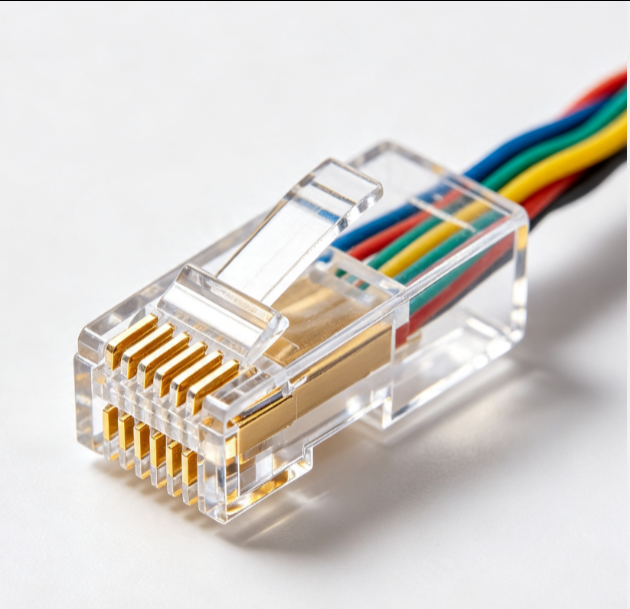
Material and structural selection is the core key that determines the transmission stability and service life of Cat6 RJ45 Keystone Jack, as well as a key identification dimension for engineering selection. The metal shrapnel of high-quality Category 6 network modules adopts high-purity gold-plating process with qualified gold-plating thickness, which has excellent conductivity, oxidation resistance and plugging resistance. It can maintain stable contact for a long time and avoid poor contact and signal interruption caused by oxidation due to frequent plugging and long-term electrification. Inferior modules mostly adopt thin gold-plating or copper-plating processes, which are extremely prone to oxidation and rust, resulting in network speed attenuation and unstable connection after six months to one year of use. In terms of shell materials, compliant products are made of high-strength flame-retardant PC materials, which have the characteristics of fire resistance, high temperature resistance, aging resistance and deformation resistance. They adapt to the closed, high-temperature and humid wiring environment of walls, eliminating potential safety hazards such as substandard flame retardancy, shell cracking and insulation failure. Meanwhile, the high-precision line position clamping structure can accurately match the wire gauge of Category 6 network cables, effectively reduce inter-wire crosstalk, and ensure lossless transmission of high-speed signals.
Accurately distinguishing shielded and unshielded models according to application scenarios and anti-interference requirements is an important principle for Cat6 RJ45 Keystone Jack selection. Unshielded Category 6 modules have a simple structure and high cost performance, suitable for home decoration, ordinary offices and indoor scenarios without strong electromagnetic interference. They can meet the basic needs of daily gigabit Internet access, audio and video transmission and office networking, and are the mainstream choice for civil scenarios. Shielded Category 6 Keystone Jacks are equipped with metal shielding shells and grounding structures, which can effectively isolate electromagnetic interference generated by surrounding strong current lines, electrical equipment and precision computer room instruments, and eliminate network fluctuation and signal distortion caused by interference. They are specially adapted to complex electromagnetic environments such as enterprise computer rooms, industrial weak current workshops, intensive strong and weak current wiring and large commercial buildings. Scenario matching shall be followed during selection. Shielded modules are not required blindly for ordinary civil scenarios to avoid cost waste, while shielded models must be adopted for complex interference scenarios, otherwise the high-speed transmission performance of Cat6 cannot be exerted.
Engineering landing selection should also focus on adaptability and construction compatibility to ensure efficient and compliant implementation of wiring projects. Cat6 RJ45 Keystone Jack adopts standard universal Keystone opening specifications, compatible with all conventional network panels, distribution frames and desktop information boxes, with strong universality and serving as a universal accessory for standardized wiring. Priority shall be given to tool-free or easy-wiring modules during selection. Tool-free modules do not require professional wiring tools, featuring convenient wiring and high fault tolerance, suitable for home decoration and small-scale engineering construction. The buckle-type stable structure can firmly lock the network cable cores to prevent line loosening and falling off, adapting to long-term high-frequency use scenarios. Meanwhile, it is necessary to match the overall specifications of the wiring system. Whole-house Cat6 wiring must be uniformly matched with Category 6 modules, and the mixed matching of Category 6 network cables with Category 5e modules is prohibited, so as to avoid the overall network failing to reach gigabit transmission standards due to performance limitation of low-end accessories.
From the perspective of long-term operation and maintenance and cost performance, the scientific selection of Cat6 RJ45 Keystone Jack can greatly reduce network fault probability and later operation and maintenance costs. High-quality and compliant Category 6 modules have a service life of more than ten years, with stable transmission performance and no obvious attenuation throughout the whole cycle, requiring no frequent maintenance and replacement. In contrast, inferior non-standard modules have high failure rates and short service life, and are prone to problems such as poor contact, network stuttering and point failure in the later stage, resulting in extremely high rework and maintenance costs. In home decoration, commercial and engineering wiring, adhering to the core selection criteria of standard parameters, high-quality materials and scenario adaptation and selecting formal Cat6 RJ45 Keystone Jack can maximize the high-speed performance of Category 6 wiring systems, ensure stable, compliant and long-term operation of network links, and serve as the basic key to quality improvement and cost reduction of integrated wiring projects.
-

-

-

-

-

-

-

-

-

-

Dustproof Cover Equipped Network Patch Panel
Oct 10, 20261117
-

How to wire a French switch outlet
Oct 28, 20261112
-

Network Cable Break Point Detector Tester
Oct 09, 20261089
-

Cat6 Lan Cable Length Limit for Gigabit
Oct 24, 20261085
-
RJ45 Connector Cat6 for DIY Cable Making
Nov 20, 20261032