- Language
Cat6 SFTP patch lead
In scenarios with complex electromagnetic conditions such as industrial control, high-density server rooms and weak-current automation systems, ordinary unshielded network cables are vulnerable to electromagnetic noise emitted by surrounding equipment, which may lead to signal jitter and transmission bit errors. For a stable and reliable cabling scheme, apart from fixed permanent links embedded in structures, the shielding performance and signal fidelity of movable patch leads are equally important. This type of finished category 6 patch lead with composite shielding is designed for LAN interconnection in high-interference environments. It balances bandwidth performance defined by category 6 standards and interference resistance, making it a common choice for network connections in noisy working conditions.
Composite shielding construction distinguishes it from ordinary unshielded and single-shielded cables. Each of the four twisted pairs inside the cable is wrapped with individual aluminium foil, and a metal braided mesh serves as an overall outer shield. This dual protection suppresses both internal crosstalk between pairs and external electromagnetic radiation from power supplies, frequency converters, servo drives and high-voltage cables. Aluminium foil performs well against high-frequency interference, while the braided mesh delivers superior mechanical toughness and resists shielding breakage under bending and tension. Combined, they provide greater tolerance to interference than single-shielded alternatives. The cable supports a rated bandwidth of 250 MHz, stable gigabit Ethernet transmission over a standard 100-metre channel and 10-gigabit transmission for shorter runs. It is backward compatible with 100-megabit networks and fits mixed deployments of new and legacy hardware.
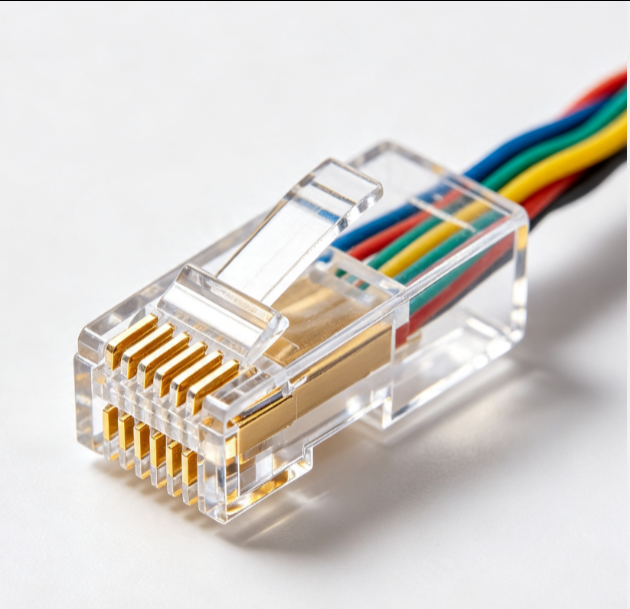
Most conductors inside adopt a stranded structure. Compared with solid-core cables used for fixed in-wall installation, stranded conductors offer greater flexibility, suitable for repeated port adjustment and frequent plugging inside racks. The twist rate of each pair is precisely controlled. With supporting cross separators and individual foil wrapping, key parameters including near-end and far-end crosstalk are well controlled to preserve signal integrity. Insulation is made of polyethylene formulated for long-term data transmission. Outer jackets are available in PVC and LSZH variants. LSZH jackets release fewer toxic fumes when exposed to heat or flame, ideal for enclosed server rooms, underground cable ducts, hospitals, rail transit stations and other sites with strict fire regulations. Shielded RJ45 connectors are pre-terminated at both ends to maintain continuous electrical contact with the cable shielding layer. Gold-plated contacts slow oxidation and reduce intermittent disconnection and packet loss after repeated plug cycles. Some variants are equipped with snagless boots to protect the connector latch from damage during cable management.
Its application scope is clearly oriented toward locations with dense interference sources, such as network communication between industrial control cabinets, links between automation production line sensors and switches, patch connections inside high-density racks, centralised security monitoring rooms and broadcast control rooms. In these areas, numerous power cables and frequency conversion devices continuously emit electromagnetic signals. Using unshielded patch leads may result in unstable speed, video stuttering and abnormal PoE power delivery. For regular offices and residential spaces with clean electromagnetic environments, higher-cost shielded cabling is generally unnecessary, and standard unshielded cables can meet demands. Selection should follow actual site conditions to avoid redundant investment.
One critical rule for shielded cabling is often overlooked during construction: shielding layers require reliable earthing. Discontinuous shielding pathways or improper earthing at both ends will stop the shield from working as intended, and may even turn the shielding structure into an antenna that picks up extra noise. Before installation, an earthing plan should be prepared to ensure continuous conductivity across patch lead shells, shielded patch panel modules and rack earthing buses, with earthing resistance meeting cabling specifications. This is the most obvious difference between shielded and unshielded installation. Even high-grade cables cannot deliver designed performance without proper earthing.
Another widespread misconception is focusing only on backbone cable specifications while ignoring supporting patch leads. The performance of an entire network channel is capped by its weakest component. Even if embedded shielded backbone cables meet standards, unmatched patch leads will limit the noise immunity of the whole channel and reduce the return on investment for backbone cabling. As movable and replaceable parts of the link, patch leads need to be tested for attenuation, crosstalk and shielding continuity during cabling acceptance.
Several maintenance practices help extend service life. Observe the minimum bend radius during routing, avoid sharp folds and heavy compression to prevent cracking of internal foil shielding. Maintain safe separation from power cables to reduce coupling interference. Hold the connector shell rather than pulling the cable body during plugging and unplugging. Colour-code cables inside racks and attach labels to simplify troubleshooting, port rearrangement and future expansion. Dust caps for unused ports protect contacts and shielding surfaces from degradation caused by dust and moisture.
For long-term network planning, gigabit remains the dominant access speed in many industrial and surveillance applications. This composite shielded patch lead reliably supports file transfer, real-time video backhaul, industrial protocol communication and PoE power delivery over extended service cycles. It can also work with higher-grade backbone cables during future upgrades, reserving space for network evolution.
In summary, composite shielded category 6 patch leads form an essential supporting component in professional shielded cabling systems. Multi-layer shielding preserves signal stability under harsh electromagnetic conditions, while retaining broad compatibility and mechanical durability. When building industrial networks or high-density data room networks, rational selection based on local electromagnetic noise, fire codes and earthing conditions, paired with standard termination, earthing and channel testing, maximises the advantages of shielded cabling and builds a robust, long-lasting data transmission pathway with strong anti-interference capability.
-

-

-

-

-

-

-

-

-

-

Dustproof Cover Equipped Network Patch Panel
Oct 10, 20261117
-

How to wire a French switch outlet
Oct 28, 20261112
-

Network Cable Break Point Detector Tester
Oct 09, 20261089
-

Cat6 Lan Cable Length Limit for Gigabit
Oct 24, 20261085
-
RJ45 Connector Cat6 for DIY Cable Making
Nov 20, 20261032