- Language
Cat7 Ethernet Cable 1m: How a Short Patch Cord Is Used in a 600 MHz Shielded System, and How to Accept It
1. Where a One-Metre Cord Sits in a Category 7 System
Inside a rack, length gets overlooked more often than category. A one-metre Cat7 cord points to a very specific set of links: between switch stacking ports, from a server network card to the top-of-rack switch, between neighbouring modules on a patch panel, and between out-of-band management ports and KVM consoles. Distances in these positions usually run from a few tens of centimetres to one metre. Three metres drags out a bundle of slack that has to be managed; 0.3 m tends to break the bend radius. One metre is just enough to route through a cable manager and still leave hand room for plugging. Because of the double shield, Category 7 cable is stiffer, so the margin at this length is smaller than with unshielded cable, and the actual routing path should be measured before ordering.
2. A Short Cord Magnifies Weaknesses in Plug Workmanship
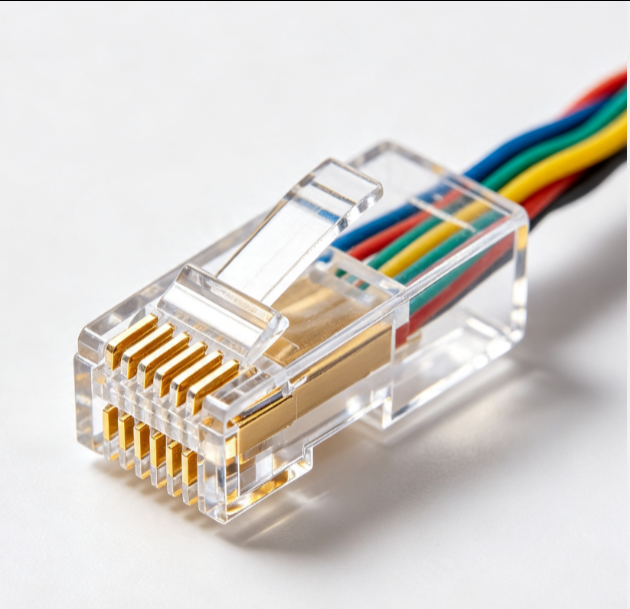
On a one-metre cord, the transition between plug and jacket takes up a significant share of the total length, so contact between shield housing and foil, tightness of the crimp and quality of the eight conductor terminations are all amplified in the measured numbers. Category 7 uses foil around each pair plus an overall braid, and the shield housing inside the plug has to bond reliably to every layer. A metal shell that is only cosmetic, with no continuous path inside, degrades crosstalk and shielding performance at high frequency. Short cords are also plugged and unplugged repeatedly, so the latch, crimp points and housing absorb more concentrated mechanical stress than on longer cords; after a few bends, the joint at the base of the plug is usually where trouble starts. If only visual inspection is possible, ask the supplier for a cross-section drawing or open one sample, which is more reliable than reading a brochure. One further caution: an RJ45 version of Category 7 has no standing in the standard, and short-cord listings are more likely to state only a category without naming the standard system, so confirming the connector system before ordering saves detours.
3. How to Test a Short Cord at 600 MHz
A short link has very low insertion loss, the numeric differences on the instrument get compressed, and verdicts on near-end crosstalk and return loss depend more heavily on the test fixture and termination quality. Standard practice is to test short cords separately at component level rather than folding them into a channel for convenience. The test range has to reach 600 MHz, and the configuration, the condition of the reference cords and the length should all appear in the report. If the documentation offers only a pass verdict with no frequency range or configuration, its value is limited. Length tolerance is worth measuring as well: a product marked one metre may have a net length anywhere from 0.95 m to 1.05 m. Too short forces equipment to be moved during installation; too long turns cable management into a mess.
4. What to Check in Purchasing and Incoming Inspection
Start with print and packaging. Reputable products mark category, gauge, shield construction, certification number and metre marks on the jacket, and the packaging states length and batch, which makes mixed lengths easy to spot. Next, the connector: is the shield housing flat, does the latch spring back properly, is the moulding free of flash and bubbles. Third, batch consistency: draw ten pieces from the same batch and their insertion feel and flexing behaviour should be close. Fourth, check whether the bonding arrangement matches: does the rack have equipotential bonding, are outlets and patch panels on the same shielding platform. If the cords move to a shielded version while the outlets stay unshielded, the margin of the whole link is set by the weaker element. Finally, verify that the test report corresponds to the model and length, rather than accepting one generic report for every variant. After delivery, keep a simple record linking each batch and sample result to its installed location, so a later problem can be traced to a specific batch quickly.
5. Conclusion
A one-metre Category 7 cord looks unremarkable, yet it involves four things at once: plug workmanship, shield continuity, test methodology and the bonding arrangement around it. Buy it as a commodity and problems surface only when the link runs at high frequency; treat it as a component and confirm each item, and this segment inside the rack holds up. For adjacent ports in the same rack, one metre is the right choice; for cross-rack, cross-row and horizontal cabling, other arrangements apply.
-

-

-

-

-

-

-

-

-

-

Dustproof Cover Equipped Network Patch Panel
Oct 10, 20261117
-

How to wire a French switch outlet
Oct 28, 20261112
-

Network Cable Break Point Detector Tester
Oct 09, 20261089
-

Cat6 Lan Cable Length Limit for Gigabit
Oct 24, 20261085
-
RJ45 Connector Cat6 for DIY Cable Making
Nov 20, 20261032