- Language
R&D Framework and Performance Iteration Ideas for High-Frequency Copper Links
The deployment of high-speed copper cabling products involves far more than raw material assembly and appearance forming. Stable performance of the complete link relies on an integrated research and development system built over time, covering material simulation, structural optimization, process calibration and reliability verification. Within the high-frequency transmission range up to 600 MHz, signals are highly sensitive to impedance fluctuation, shielding discontinuity and twist deviation. Minor structural deviations may trigger excessive crosstalk or return loss, which raises stricter requirements for refined control during R&D.
The first phase of R&D is building simulation models based on international specifications, with ISO/IEC 11801 Class F metrics as the benchmark, to pre-simulate pair structures, dielectric materials and shielding layouts. R&D teams adopt electromagnetic simulation tools to calculate how the dielectric constant of insulation materials, foil overlap ratio and braid coverage affect coupling attenuation and alien crosstalk. Unlike low-frequency cables tuned by experience, high-frequency links require pre-judgment of signal coupling paths in a virtual environment. Multiple shielding layouts are compared to select a structure that balances impedance balance and bending durability. The simulation also distinguishes permanent cabling from movable cords. Products for movable connections must retain stable electrical parameters under repeated plugging and bending, so the matching logic for conductors, jackets and shielding differs greatly from solid cabling.
Material formulation and matching selection form one core segment of R&D. Conductor composition, insulation foaming ratio, shielding alloy components and polymer jacket formulas all directly alter attenuation features of high-frequency signals. Multiple comparative sample groups are prepared and evaluated to check how oxygen-free copper purity and insulation foaming uniformity impact skew and impedance consistency. For shielding layers, combinations of aluminum foil of different thicknesses and copper braids with varied density are verified for shielding continuity after temperature cycling and humidity aging. Environmental and fire safety requirements are also addressed. Low-smoke zero-halogen jacket formulas must balance flame resistance, low-temperature brittleness and extrusion processability. Many formulations pass static testing yet develop structural defects after high-speed extrusion and molding. Researchers therefore adjust additive ratios continuously to fit mass production.
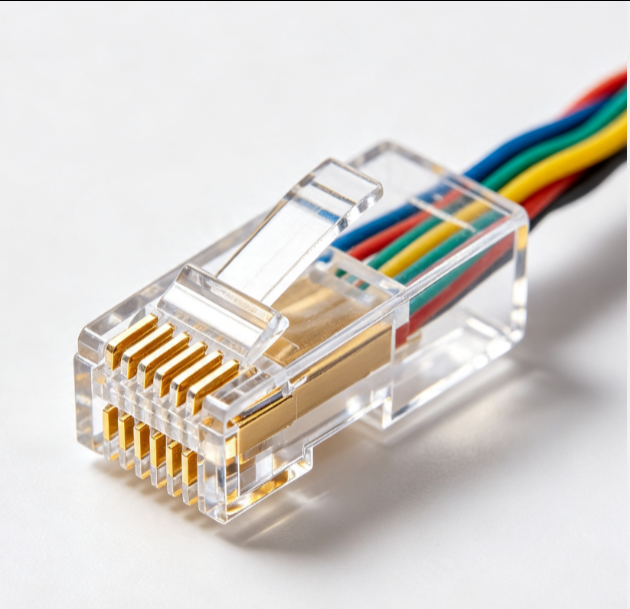
Calibration of twisting and shielding termination processes presents a major difficulty in high-frequency cabling development. The four twisted pairs adopt distinct twist pitches with back-twist control to reduce residual stress after cabling. This prevents pitch shift during later bending that would break the balanced electrical structure. Tension and overlap width for individual foil wrapping on each pair must be quantified and locked. Insufficient overlap creates electromagnetic leakage, while excessive overlap causes local impedance discontinuity. The plug termination zone is the weakest point of the whole channel. R&D designs transitional shielding structures to smoothly connect internal cable shielding with shielded RJ45 shells and eliminate shielding gaps. These parameters cannot be copied directly from lower-grade cabling; hundreds of termination, disassembly and retest cycles are needed to establish stable operating specifications.
Reliability test platforms are essential to close the R&D loop. Once prototypes are finished, they are not released directly for application. Instead, they go through a sequence of accelerated aging tests including temperature cycling, damp heat aging, plug cycling, repeated bending and vibration shock. Electrical parameters across the full frequency band are logged continuously during testing to track performance drift over aging time and evaluate long-term margin. Many samples meet specifications in initial tests, yet suffer loose shielding contacts or tiny insulation deformation after repeated plugging or temperature changes, leading to rapid crosstalk degradation. Such risks can only be uncovered through long-duration reliability tests, with findings fed back into structural and process revisions.
Besides hardware development, testing methodologies and quality criteria also fall within the scope of R&D. High-frequency link certification imposes strict rules for instrument calibration, fixtures and termination methods. R&D teams build standard-compliant test environments and define unified workflows and threshold values to support batch quality inspection. Scene-oriented adaptations are also developed, such as oil-resistant and drag-resistant variants for industrial settings and flame-retardant low-smoke versions for enclosed machine rooms. Protective jackets are adjusted while core electrical indicators remain unchanged.
In summary, the competitiveness of high-performance movable cabling assemblies comes from coordinated capacity across the whole R&D chain, rather than advantages in a single material or process. Quantitative control covering electromagnetic simulation, material development, process validation and long-term reliability testing ensures that high-frequency links can steadily carry 10G Ethernet services after delivery. A mature R&D system lays the foundation to adapt to diverse project requirements and sustain continuous product upgrades.
-

-

-

-

-

-

-

-

-

-

Dustproof Cover Equipped Network Patch Panel
Oct 10, 20261117
-

How to wire a French switch outlet
Oct 28, 20261112
-

Network Cable Break Point Detector Tester
Oct 09, 20261089
-

Cat6 Lan Cable Length Limit for Gigabit
Oct 24, 20261085
-
RJ45 Connector Cat6 for DIY Cable Making
Nov 20, 20261032