- Language
Stable Links with Double Shielding: Core Characteristics of a Cat7 Copper S/FTP Patch Cord
In cabling environments with complex electromagnetic conditions such as data centres and industrial control cabinets, Cat7 shielded patch cords maintain high-frequency signal integrity through a unique structure and serve as essential components in 10G copper links. This article focuses on the cat7 copper SFTP patch cord, outlining its core characteristics from electrical performance, shielding construction, conductor material, connector design, jacket options and compatibility, to help engineers identify product differences and match project requirements.
This patch cord complies with Class F performance under ISO/IEC 11801, reaching a bandwidth of 600 MHz and supporting 10GBASE-T transmission. Within the specified channel range, it can carry high-speed data steadily. Compared with Cat6A, it provides extra frequency margin, leaving more allowance for attenuation and crosstalk. It suits high-density racks and networks with heavy concurrent traffic. It also supports PoE standards, enabling power supply and data transmission for cameras, wireless access points and other powered terminals, which fits integrated structured cabling.
Double S/FTP shielding is its most distinctive feature. Each twisted pair is individually wrapped with aluminium foil to suppress pair-to-pair crosstalk, and the whole four-pair bundle is covered by an outer metal braid against external electromagnetic noise from inverters and power cables. The two layers work separately. Compared with single-shielded or unshielded cords, it delivers more stable signals in noisy areas. However, the structure relies on continuous shielding. Reliable bonding between shield foil, shield clip and metal plug shell is required; broken bonding will weaken noise suppression significantly.
The conductor is stranded solid copper, commonly available in 24AWG and 26AWG. Stranded construction is more flexible than solid cable, which fits patch cords that are frequently plugged and bent inside racks. High-purity copper brings low DC resistance and limited high-frequency attenuation to preserve signal quality up to 600 MHz. Copper-clad aluminium and other substitute materials introduce higher attenuation and struggle to meet Class F consistently, which is a major source of performance gaps among similar products.
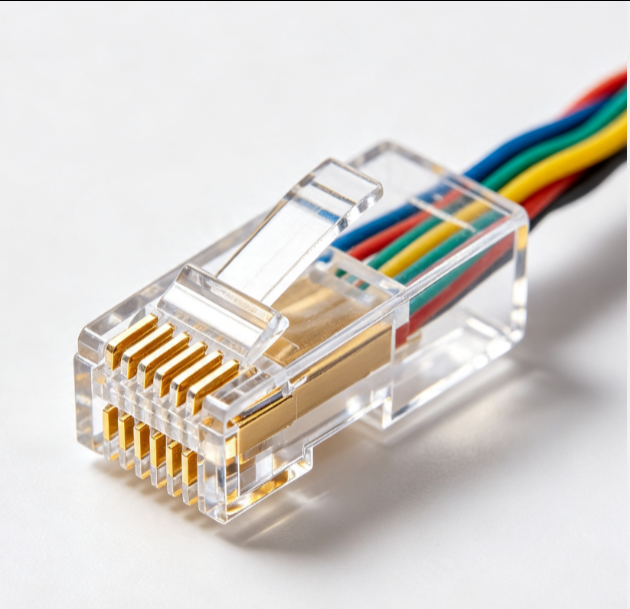
Connector design greatly affects overall performance. The shielded RJ45 metal shell and shield clip create 360-degree bonding for a continuous shielding path. Gold-plated contacts reduce contact resistance and oxidation for stable connection after repeated mating. Phosphor bronze contact bases maintain stable spring force and resist loose contact over time. A strain-relief boot at the plug end reduces pulling stress on conductors and shielding during bending, lowering long-term failure risk.
Jackets are available in PVC and LSZH for different environments. PVC is flexible and cost-effective for ordinary machine rooms and office cabinets. LSZH jackets produce low smoke and low toxicity when burning, preferred for enclosed tunnels, metro passages and building risers with strict fire safety rules. The jacket is wear-resistant and reduces damage during frequent cable rearrangement in racks.
Backward compatibility is another practical trait. A Cat7 patch cord works in Cat6A, Cat6 and Cat5e systems, though the overall link performance is limited by the lowest-grade component in the channel. There are RJ45, GG45 and TERA versions. RJ45 is compatible with common network ports, while GG45 and TERA deliver better high-frequency performance but less interoperability. The connector type must match patch panels and ports before purchase.
Its limitations should also be noted. The double-shielded design demands careful termination and proper grounding. Both ends of the shielded link need equipotential bonding, and a floating shield may pick up induced noise. It also costs more than unshielded alternatives, so its advantages cannot be fully utilised in ordinary office spaces without strong interference.
In summary, this type of patch cord features high bandwidth, double shielding, low-loss copper conductors, durable connectors and optional jackets. It is not a universal upgrade for all cables, but a specialised component built for high-noise 10G applications. Its electrical advantages can only be fully realised when deployed according to site conditions.
-

-

-

-

-

-

-

-

-

-

Dustproof Cover Equipped Network Patch Panel
Oct 10, 20261117
-

How to wire a French switch outlet
Oct 28, 20261112
-

Network Cable Break Point Detector Tester
Oct 09, 20261089
-

Cat6 Lan Cable Length Limit for Gigabit
Oct 24, 20261085
-
RJ45 Connector Cat6 for DIY Cable Making
Nov 20, 20261032