- Language
Technical Essentials and Performance Evaluation Reference for Category 8 Patch Cord Cabling
As high-speed Ethernet continues to evolve, copper cabling systems are advancing toward higher bandwidth. Category 8 twisted-pair links serve as an important cabling solution for short-reach, high-throughput scenarios. During the selection phase, many project planners consider not only transmission metrics but also the craftsmanship, testing standards and long-term stability of supporting cords to match high-speed electrical port services such as 25GBASE-T and 40GBASE-T.
Under international specifications, Category 8 cabling follows ISO/IEC 11801 and TIA-568 standards, divided into Class I and Class II. The link is rated for 2000 MHz bandwidth and supports data transmission up to 40 Gbps, with a maximum standardized channel length of 30 meters. This distance limit is not a flaw in cable quality. At high frequencies, crosstalk, return loss and insertion loss degrade rapidly over copper media, and the standard uses this cap to guarantee performance margin. Compared with Category 6A, Category 8 operates at four times the frequency and imposes stricter requirements on shield continuity and termination quality. Nominal performance cannot be achieved simply by swapping the cable.
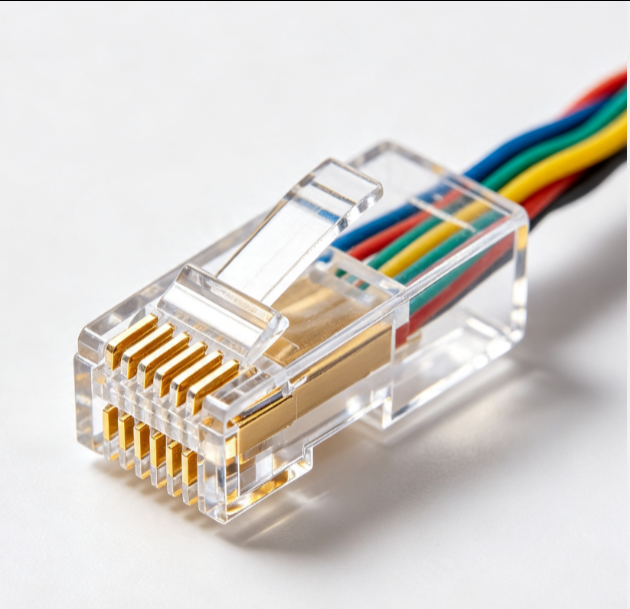
Structurally, qualified Category 8 patch cords generally adopt S/FTP fully shielded construction. Each wire pair is wrapped with individual foil, covered by an overall outer shield to suppress near-end crosstalk, far-end crosstalk and external electromagnetic interference. Stranded conductors are widely used to withstand frequent plugging and bending inside racks. Low-smoke zero-halogen jacket materials are common, releasing less smoke during combustion and meeting fire safety requirements for data centers and dense computer rooms. Termination is often the weakest point in a link. The shield must maintain reliable conductivity with the shielded RJ45 shell. Broken shielding or inconsistent grounding will easily cause failures at high frequencies, even if the cable conductor material meets specifications.
For application scenarios, these cords are designed primarily for short interconnections inside cabinets, such as links between top-of-rack switches and server network adapters, or between patch panels and device ports. They support backward compatibility with lower-grade ports, although throughput will be limited by upstream hardware. They are not suitable for long horizontal runs across buildings. The 30-meter channel restriction positions them as an intra-rack interconnection option rather than backbone or horizontal cabling for campus infrastructure. A common misunderstanding is that replacing cables alone enables 40G electrical networking. In fact, network adapters, switch ports, patch modules and every connector in the channel must all satisfy Category 8 requirements; overall link performance is limited by the weakest component.
Channel certification testing is mandatory for acceptance. Certified cable testers scan electrical parameters across the full frequency spectrum, including insertion loss, return loss, NEXT, ELFEXT and impedance balance. Many uncertified finished cords look intact visually but lack sufficient margin at 2000 MHz. Temperature shifts and vibration will further reduce performance headroom over time, leading to intermittent packet loss or failure to reach rated bandwidth.
When comparing solutions, planners need to balance copper and fiber alternatives. Copper electrical ports offer strong compatibility and simple commissioning with the familiar RJ45 interface. Fiber reaches much longer distances yet requires higher-cost optical transceivers. For cabinet interconnections within 30 meters, compliant Category 8 copper links provide a practical alternative.
In summary, Category 8 patch cords are components within a high-speed cabling ecosystem. Their performance depends on the complete channel. Selection should not rely merely on appearance and labeling. Verifications should cover valid third-party certification, complete shielding and standardized termination. Full-channel certification tests after installation help sustain stable 25G and 40G Ethernet services for compute clusters and storage interconnections with heavy data traffic.
-

-

-

-

-

-

-

-

-

-

Dustproof Cover Equipped Network Patch Panel
Oct 10, 20261117
-

How to wire a French switch outlet
Oct 28, 20261112
-

Network Cable Break Point Detector Tester
Oct 09, 20261089
-

Cat6 Lan Cable Length Limit for Gigabit
Oct 24, 20261085
-
RJ45 Connector Cat6 for DIY Cable Making
Nov 20, 20261032