- Language
The Value and Limits of Cat6 Patch Leads Passing Fluke Tests: Understanding Data Link Quality
In the field of structured cabling, patch leads are important accessories that connect devices to information panels, and their quality directly affects the stability of the entire data link. For acceptance inspectors, network operations staff and procurement decision makers, the statement "cat6 patch leads pass fluke test" means the link has passed standard testing and is qualified for delivery and use. But what information does this conclusion actually contain, and which details are easily overlooked? This article interprets the issue from multiple angles.
Let us first understand what Fluke testing means. Fluke is a widely used instrument family in network cabling testing, covering parameters such as attenuation, near-end crosstalk, return loss and propagation delay. During a test, the instrument generates test signals according to a preset standard template, checks the electrical performance of the link one item at a time, compares measured values with standard limits, and finally outputs a "pass" or "fail" verdict along with a detailed report. The value of this test lies in replacing subjective judgment with objective data, providing a quantifiable basis for link quality.
Cat6 patch leads belong to the Cat6 specification, supporting a bandwidth of 250 MHz and holding a mainstream position in the standard cabling system. Unlike permanent links, patch leads are pluggable connection parts that connect terminal devices, switches or patch panels. For this reason, quality fluctuations in patch leads are more easily perceived and more likely to become the weak point of the whole link. A patch lead of poor quality, even if it causes only slight signal attenuation, may be amplified into an obvious performance problem in long-distance or high-load scenarios.
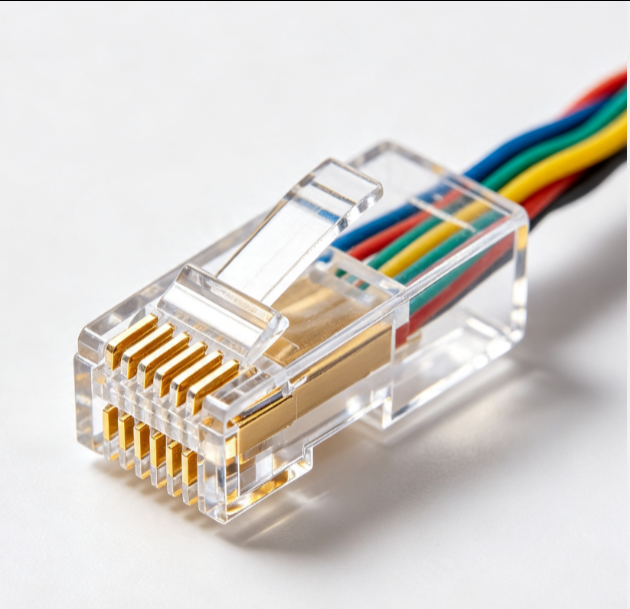
Why do some patch leads pass the test smoothly while others do not? The differences usually concentrate in several aspects. The first is conductor material. Pure copper conductors provide stable conductivity and good high-frequency characteristics, while some low-priced cables use copper-clad aluminum or composite conductors. These cost less but often fail to meet attenuation and crosstalk requirements. The second is structural workmanship. Regular pair twist and a sound cross separator effectively reduce interference between wire pairs. The third is connector quality. The thickness of gold plating, crimping workmanship and contact material all affect long-term contact stability.
It should be noted that "passing the test" is a qualification verdict and does not equal outstanding performance. A test result within standard limits counts as passing, but different patch leads may show very different margins when passing. Some test values sit close to the limit edge, while others retain ample margin. For projects with high requirements, paying attention to the test margin is more meaningful than only looking at pass or fail, because a larger margin means more headroom against temperature changes and aging loss.
Meanwhile, Fluke testing also distinguishes between different test types. Channel tests include patch leads and equipment connection cables, reflecting the actual state of the user link, while permanent link tests mainly verify the fixed construction part. During acceptance, one should clarify which test the report corresponds to and which version of the standard was adopted. The same patch lead may produce different conclusions under different standards or test types. Only by understanding the test conditions can one correctly interpret the report.
From an engineering selection perspective, if a project pursues long-term link stability, choosing Cat6 patch leads with complete test records and traceable batches is more reliable. Reputable manufacturers usually carry out strict inspection on finished cables and provide compliance statements. Buyers can ask to see inspection documentation, warranty terms and supplier qualifications, which carry more reference value than price alone. Projects should also reserve some test margin to leave room for future equipment upgrades.
Price differences are also worth attention. Qualified patch leads that pass tests often cost slightly more than ordinary ones, because inspection procedures, raw material investment and quality control are all reflected in quotations. Low-priced leads are not necessarily unqualified, but if the price clearly deviates from the market range, one should be alert to compromises in conductors or workmanship. For bulk purchases, it is advisable to run sample tests first and expand procurement only after performance is confirmed, in order to reduce overall risk.
In actual use, patch lead performance may also change due to environment. High temperature, humidity, repeated bending and external trampling can degrade parameters that were originally acceptable. During cabling, the bending radius should be controlled, excessive stretching avoided, and cables properly labeled for later maintenance. Regular retesting of important links also helps uncover hidden problems early and avoid service interruptions. Sound daily management extends the advantage of passing tests for a longer period.
From a broader perspective, "cat6 patch leads pass fluke test" reflects one part of quality control in the entire cabling system. It proves that the link meets acceptance standards, provides evidence for project delivery and establishes a baseline for later operations. However, the assurance of network quality requires coordinated cooperation across design, selection, construction, testing and operations. Patch leads are only one part, but they often determine whether the link can deliver good performance completely to terminal devices.
In summary, it is especially important to view this test conclusion rationally. One should recognize its positive role as a quality threshold, while also understanding that qualification does not equal excellence and passing does not mean permanent success. During selection, pay attention to conductor material, structural workmanship and connector quality. During acceptance, clarify the test type and standard version. During use, manage the environment well and retest periodically. Only then can the link remain stable and reliable. By securing the patch lead link properly, the quality of the entire data link is better guaranteed, and the network system can run smoothly over the long term, supporting the efficient operation of various businesses.
-

-

-

-

-

-

-

-

-

-

Dustproof Cover Equipped Network Patch Panel
Oct 10, 20261117
-

How to wire a French switch outlet
Oct 28, 20261112
-

Network Cable Break Point Detector Tester
Oct 09, 20261089
-

Cat6 Lan Cable Length Limit for Gigabit
Oct 24, 20261085
-
RJ45 Connector Cat6 for DIY Cable Making
Nov 20, 20261032