- Language
cat6 patch cable
In the structured integrated wiring system, short-distance terminal connecting wires serve as crucial hubs linking backbone wiring and terminal equipment. The overall wiring technology, construction specifications and installation details directly determine the transmission stability, service life and operation and maintenance convenience of local area networks. Compared with traditional wires, Category 6 terminal connecting wires adapted to gigabit networking feature higher bandwidth ceiling and stronger anti-interference capability. However, their excellent hardware performance can only be fully exerted relying on standardized wiring construction. From a professional wiring perspective, standardized selection, laying, termination and finishing technologies are the core keys to avoiding network faults, ensuring link compliance and realizing long-term stable networking.
The primary core of wiring construction is to control basic laying parameters in accordance with industrial standards. According to TIA/EIA structured wiring specifications, the total length of a single complete LAN link shall not exceed 100 meters, including 90 meters of fixed wall wiring and a reserved 10-meter margin for short-distance equipment connection. During construction, the bending radius of wires must be strictly controlled. Violent bending and extrusion are prohibited. Conventional laying requires a bending standard no less than four times the outer diameter of the wire to avoid distortion of the internal twisted pair pitch and prevent hidden crosstalk and signal attenuation. Meanwhile, excessive stretching, rolling and damage to wires should be avoided throughout the process to retain the complete transmission performance of wires in basic laying.
The separation of strong and weak current wiring is a core anti-interference criterion for wiring projects and a key factor for realizing the performance of Category 6 wires. Network signals belong to weak-current high-frequency signals, which are extremely vulnerable to electromagnetic radiation interference from strong-current alternating current, causing network speed fluctuations, packet loss and delay. Standard construction requires that the parallel laying distance between network wires and 220V power cables shall not be less than 30 centimeters. If lines have to cross, a 90-degree vertical crossing method shall be adopted, and tin foil wrapping protection can be used when necessary to isolate electromagnetic interference to the maximum extent. In addition, the wiring path should be kept away from interference sources such as transformers and high-power electrical appliances to create a pure signal environment for data transmission.
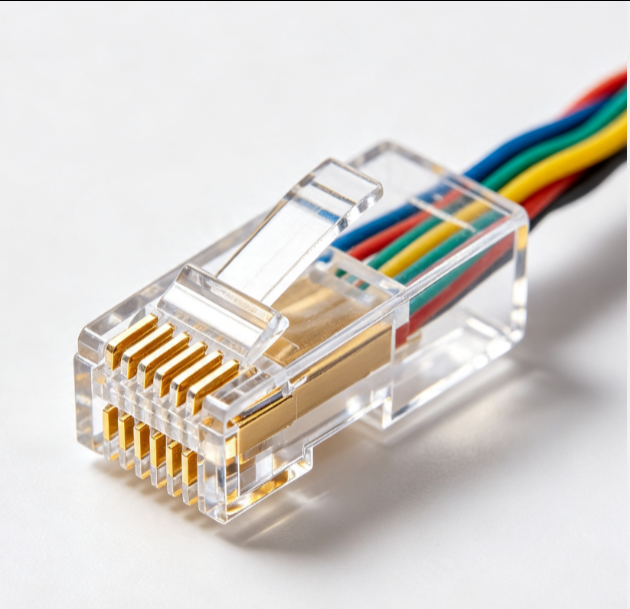
The standardization of termination technology is the core difference between professional wiring and simple connection. All connector production must strictly follow the universal T568B line sequence standard. The eight core wires shall be sorted and arranged flatly to avoid disordered or mixed line sequences. When crimping crystal heads, ensure that the wire cores are fully inserted to the bottom and fit the metal contacts tightly, and compress the buckles to ensure firm connection, so as to prevent intermittent network disconnection caused by virtual connection and loosening. For the termination construction of computer room distribution frames and wall information panels, professional wiring tools shall be used to fix the wire cores and ensure firm contact engagement. Each link shall be tested for continuity and signals after construction to ensure that the link parameters meet standards.
Scene-adapted wire selection and wiring are also indispensable. Different scenarios such as home networking, enterprise office and security monitoring have varying requirements for wire flexibility, wear resistance and flame retardancy. Oxygen-free copper core wires are preferred for conventional indoor scenarios due to lower resistance, more stable transmission and better anti-oxidation and anti-aging performance for long-term use. For dense computer room wiring scenarios, wires with flame-retardant and environmentally friendly sheaths should be selected to improve circuit safety and facilitate orderly arrangement and storage. During the wiring process, lines shall be classified and labeled to distinguish lines for office use, monitoring, wireless AP and other purposes, facilitating subsequent fault troubleshooting, network upgrading and line operation and maintenance.
In addition, the finishing and protection technology after wiring directly affects the service life of the network system. Excess wires shall be neatly coiled and stored in order to avoid messy stacking, winding and knotting, which may cause long-term compression deformation and sheath damage of wires. Wires in weak current boxes and cabinets shall be firmly fixed to prevent long-term stress loosening of interfaces, and the wiring area shall be kept ventilated and dry to reduce corrosion and loss of lines and interfaces caused by moisture and dust. Standardized finishing technology can effectively reduce subsequent network failure rates and greatly improve the stability and durability of the wiring system.
In conclusion, high-quality wires are only the foundation of high-performance networking, and standardized and refined wiring construction is the core guarantee for stable network operation. Every wiring detail ranging from parameter control and anti-interference laying to standard termination and orderly storage affects link transmission quality. Strictly implementing construction in line with professional wiring specifications can fully release the gigabit transmission advantages of Category 6 wires, avoid various hidden network problems, build a standardized local area network system with stability, high efficiency and easy maintenance, and meet the long-term usage needs of various digital scenarios.
-

-

-

-

-

-

-

-

-

-

Dustproof Cover Equipped Network Patch Panel
Oct 10, 20261117
-

How to wire a French switch outlet
Oct 28, 20261112
-

Network Cable Break Point Detector Tester
Oct 09, 20261089
-

Cat6 Lan Cable Length Limit for Gigabit
Oct 24, 20261085
-
RJ45 Connector Cat6 for DIY Cable Making
Nov 20, 20261032