- Language
cat6a SFTP patch lead
With the continuous expansion of digital services, computer rooms, enterprise wiring closets, intelligent control rooms and other environments keep raising requirements for network bandwidth and transmission stability. Video clusters, virtualized servers and storage interconnection services all demand higher standards for copper cabling systems. In environments with complex electromagnetic signals, ordinary unshielded network cables are vulnerable to interference from nearby power cables, frequency conversion equipment and radio frequency signals. Packet loss and unstable latency may occur and disrupt continuous operation of upper-layer applications. For this reason, properly selected patch cords with sufficient bandwidth and anti-interference performance play an essential role in structured cabling systems.
Under cabling standards, augmented category 6 cables support stable 10-Gigabit Ethernet transmission and deliver ample bandwidth for copper links over longer distances. Shielded constructions further improve cable performance in noisy environments, and different shielding designs vary greatly in crosstalk suppression and electromagnetic protection. There are single-shielded and double-shielded options. The double-shielded design wraps each twisted pair with individual aluminum foil, plus an outer braided shield. This dual-layer protection suppresses internal crosstalk between pairs and blocks external electromagnetic noise. The advantages become obvious in dense rack layouts where many cables are bundled tightly together.
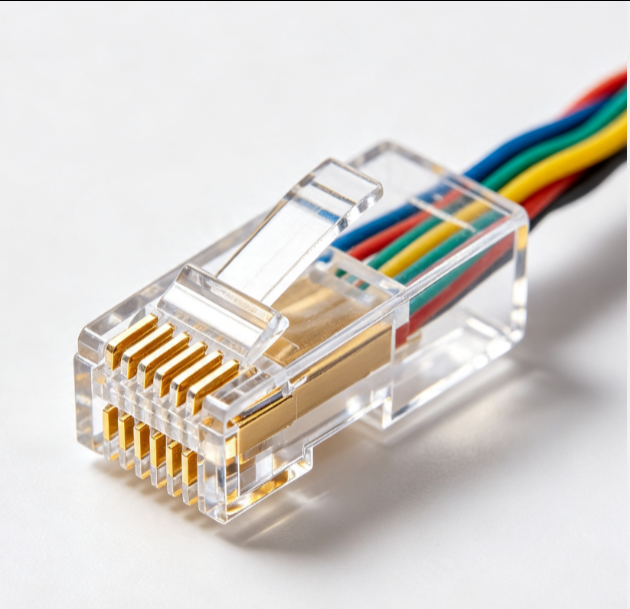
Patch cords are factory-terminated assemblies fitted with standard RJ45 connectors at both ends for short connections between switches, patch panels, servers and end devices. Compared with field-terminated cables, factory-made cords feature consistent twist rates, properly finished shielding layers and standardized termination, which help preserve channel performance. Field termination often brings risks such as untwisted pairs, poorly managed shields and misaligned pinouts. These defects easily become weak points in the channel and tend to surface under 10G high-speed traffic.
Conductor and jacket materials deserve careful review during selection. Oxygen-free copper conductors maintain lower resistance and better attenuation control for stable long-term operation. Common jacket options include low-smoke zero-halogen and PVC. Low-smoke zero-halogen jackets produce limited smoke and toxic emissions during combustion, making them suitable for enclosed server rooms and building risers with strict fire safety rules. PVC jackets offer good flexibility and economical value for general office deployment. Slim variants use thinner gauge conductors with smaller outer diameter and tighter bend radius. They simplify cable management in crowded racks, improve airflow and ease thermal pressure caused by congested wiring.
Many field practices affect channel performance during installation and operation. Proper grounding is critical for shielded systems. Improper grounding breaks shielding continuity and may introduce extra noise through ground loops. Installers must maintain continuous shield contact at both ends and equalize ground potential. Cables should never be sharply bent or squeezed beyond the minimum bend radius specified by the standard. Severe stress can damage the twist structure and foil layers, leading to gradual performance degradation. During planning, network cables should be separated from power cables with adequate clearance to reduce coupled interference.
Augmented category 6 compliant links offer backward compatibility with category 5 and 5e hardware. This allows phased network upgrades without full replacement of existing cabling infrastructure. Such links also support Power over Ethernet to supply power for wireless access points, security cameras and compact terminals, simplifying on-site wiring and eliminating separate power runs.
Professional cable testers are recommended for acceptance testing. Key metrics include insertion loss, return loss, near-end crosstalk and alien crosstalk to verify compliance with relevant standards. Visual inspection alone cannot validate internal shielding integrity and electrical performance.
High-speed shielded patch cords are far more than simple connecting accessories; they form a vital segment of the whole cabling channel. In industrial control, data center, security cluster and large office systems with harsh electromagnetic conditions and high availability requirements, correct selection, standardized installation and routine maintenance of shielded patch cords sustain reliable 10G operation and reduce network failure risks. They lay a stable physical foundation for digital services. The value of a cabling solution does not rely on overstated specifications of one single component, but on consistent specifications across design, procurement, installation and validation of the entire channel.
-

-

-

-

-

-

-

-

-

-

Dustproof Cover Equipped Network Patch Panel
Oct 10, 20261117
-

How to wire a French switch outlet
Oct 28, 20261112
-

Network Cable Break Point Detector Tester
Oct 09, 20261089
-

Cat6 Lan Cable Length Limit for Gigabit
Oct 24, 20261085
-
RJ45 Connector Cat6 for DIY Cable Making
Nov 20, 20261032