- Language
cat6a patch codes pass fluke test
With the rapid development of cloud computing, big data, 4K/8K high-definition transmission, industrial Internet of Things and ultra-large-scale data centers, traditional gigabit networks can no longer meet the transmission needs of modern commercial and industrial scenarios, and the full implementation of 10-gigabit networks has become the mainstream trend of the industry. As a key component with frequent plugging and dynamic connection in network links, the transmission performance, anti-interference ability and long-term stability of Cat6A patch cords directly determine the throughput efficiency and operation and maintenance quality of the overall network. In the industry engineering acceptance system, passing the complete set of Fluke link performance tests is an authoritative core standard to measure whether Cat6A patch cords comply with international wiring standards and have commercial implementation qualifications. It is also a rigid requirement for high-end network engineering bidding, project acceptance and quality traceability.
Cat6A patch cords are high-end wiring accessories specially designed for 10-gigabit high-speed networks. Compared with Cat5e and Cat6 patch cords, they have achieved key performance breakthroughs. Featuring a standard bandwidth of 500MHz, twice that of ordinary Cat6 cables, they stably support 10Gbps 10-gigabit data transmission without performance attenuation at the standard wiring distance of 100 meters. They are perfectly applicable to high-bandwidth, low-latency and high-reliability transmission scenarios such as high-density server clusters in data centers, enterprise core office networks, smart parks, industrial automatic control and high-definition security monitoring. Non-standard Cat6A patch cords that fail to pass Fluke tests generally have process defects including insufficient conductor purity, unbalanced pair twisting pitch, uneven insulation layer thickness and rough crystal head termination. These defects easily cause crosstalk, signal attenuation and excessive return loss in high-density wiring environments, further triggering common network faults such as packet loss, latency fluctuation, link disconnection and insufficient bandwidth, which seriously hinder the normal operation and long-term upgrading of network systems.
The Fluke test system is recognized as a rigorous and authoritative detection standard in the global wiring industry. Different from simple continuity test and appearance inspection on the market, it conducts all-round precision detection on dozens of core electrical performance parameters of patch cords in accordance with TIA/EIA-568.2-D and ISO/IEC 11801 international universal wiring specifications. The detection items cover insertion loss, return loss, near-end crosstalk, far-end crosstalk, integrated crosstalk, attenuation-to-crosstalk ratio, transmission delay and delay skew, fully covering all core factors affecting signal quality in high-speed network transmission. Only Cat6A patch cords with all parameters fully compliant and no data over-limit can pass the complete Fluke test and obtain an authoritative test report. It professionally verifies that the electrical performance, processing technology and structural design of the products fully meet international high-end wiring standards, eliminating industry chaos such as false parameter labeling and performance shrinkage.
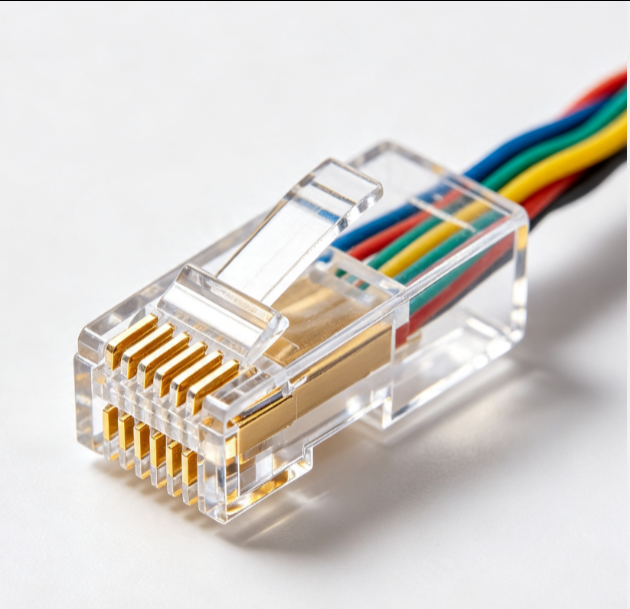
All Cat6A patch cords that have passed the full set of Fluke performance tests follow a strict production and quality control system with strict checks from raw material selection to finished product termination. Made of high-purity oxygen-free copper solid conductors, the patch cords feature high conductivity and uniform resistance, which can minimize energy loss during high-speed signal transmission and ensure the integrity and stability of big data and high-frequency signal transmission. The wire pairs adopt precise symmetrical twisting technology with strictly controlled pitch error, paired with high-density flame-retardant polyethylene insulation layers, which effectively isolate electromagnetic interference between wire pairs and greatly enhance the link anti-interference ability, adapting to complex working conditions such as dense computer room wiring, complex industrial electromagnetic environments and building integrated wiring. Both ends of the patch cords are equipped with crystal heads with thickened gold-plated contacts, which have excellent anti-oxidation and anti-corrosion properties. They can withstand thousands of repeated plugging and unplugging cycles and maintain accurate fitting and stable contact for long-term use, avoiding network faults caused by loose termination. The outer sheath is made of environmentally friendly flame-retardant PVC or LSZH material, with wear resistance, tensile resistance, aging resistance, moisture resistance and flame retardancy, suitable for installation in various indoor and outdoor scenarios and effectively extending the service life of network links.
In practical engineering applications, Fluke-certified Cat6A patch cords have strong versatility and forward compatibility, compatible with various network devices such as switches, routers, servers and storage devices, and suitable for the upgrading and transformation of new and old network systems. Their stable low-latency and high-bandwidth transmission capabilities can fully meet the core business needs such as cloud collaborative office, real-time video conferencing, ultra-high-definition video transmission, real-time industrial data collection and parallel big data computing, completely solving network stuttering, bandwidth bottlenecks and business interruptions caused by non-standard patch cords, and greatly reducing later network operation and maintenance costs and fault incidence. For network integrators, engineering enterprises and end users, selecting Fluke-tested Cat6A patch cords is not only the foundation to ensure the efficient, stable and safe operation of network systems, but also a key measure to avoid project acceptance risks, improve project quality and adapt to the iterative upgrading of future networks, serving as a standardized preferred product for modern high-end 10-gigabit network wiring projects.
-

-

-

-

-

-

-

-

-

-

Dustproof Cover Equipped Network Patch Panel
Oct 10, 20261117
-

How to wire a French switch outlet
Oct 28, 20261112
-

Network Cable Break Point Detector Tester
Oct 09, 20261089
-

Cat6 Lan Cable Length Limit for Gigabit
Oct 24, 20261085
-
RJ45 Connector Cat6 for DIY Cable Making
Nov 20, 20261032