- Language
cat7 ethernet cable
In the digital age, wired networks remain an important carrier for stable data transmission. Wireless signals are easily affected by walls, electrical appliances and spatial obstructions. In scenarios requiring continuous transmission of large volumes of data, wired cabling solutions often deliver a more stable transmission experience. To meet diverse networking demands, twisted-pair cables are classified into clear grades. Each grade corresponds to different bandwidth, anti-interference capacity and application scenarios. When planning cabling projects, users need to select suitable cables according to application scenarios, surrounding electromagnetic conditions and long-term upgrade plans.
Twisted-pair cables have gone through multiple development stages. From early Category 5 and Category 5e, to Category 6, Category 6a and higher-grade shielded cables, each standard revision focuses on reducing crosstalk, expanding bandwidth and improving signal integrity. Category 7 twisted-pair cables comply with international cabling specifications and adopt a dual-shield structure with individual shielding for each pair plus overall shielding. Each of the four twisted pairs is wrapped with a separate shield layer, and an integrated outer shield is added to isolate external electromagnetic interference and reduce crosstalk between wire pairs. It supports a bandwidth up to 600 MHz and stable 10-Gigabit Ethernet transmission, while being backward compatible with lower-grade network equipment. Compatible with mainstream RJ45 interfaces, it works smoothly with switches, storage devices, workstations and audio-video terminals.
Many users misunderstand the relationship between cable grade and external internet speed. The upper limit of external network access is determined by carrier lines, optical modems and access ports. Simply upgrading to higher-grade cables cannot directly boost external download speed. The value of such cables is reflected more in internal network transmission, such as large file transfers between multiple devices, 4K and 8K video editing, NAS storage reading and writing, and real-time rendering. After internal network hardware is upgraded to 10-Gigabit specifications, the existing cabling infrastructure can support higher-bandwidth services without full reconstruction, making it a forward-looking cabling option.
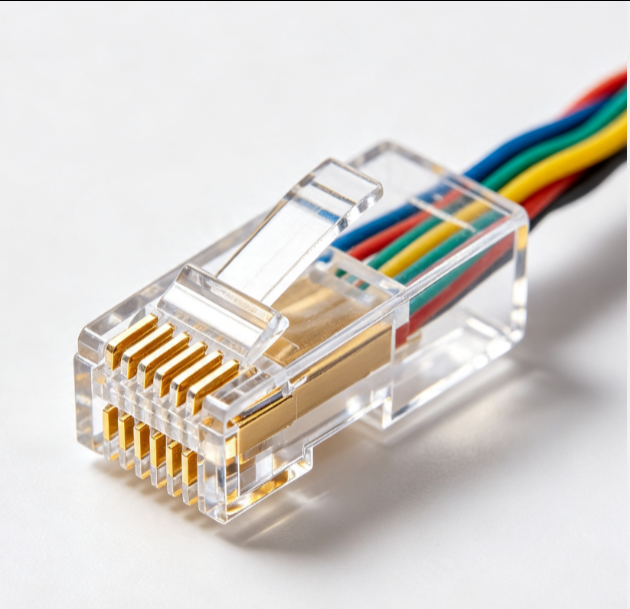
Conductor material, twist pitch craftsmanship, connector finishing and outer jacket materials jointly determine the long-term stability of cables. Reliable cables generally adopt copper conductors paired with precision twist pitch design to maintain consistent signal transmission and reduce signal skew. Connector contacts are surface-treated to slow oxidation and lower the risk of poor contact. Strain relief boots at connector ends protect inner conductors from breakage after repeated plugging and bending. The outer jacket balances flexibility, wear resistance and anti-aging performance. It resists cracking and chalking when routed inside walls, arranged in cabinets or laid on desks. Meanwhile, the materials meet conventional environmental requirements. Low-smoke zero-halogen variants offer better safety when deployed in enclosed spaces, suitable for long-term indoor installation in computer rooms, offices and residences.
The shielding structure is the core feature distinguishing these cables from ordinary unshielded variants. Nevertheless, shielded cables require extra attention during installation. The shielding system is an integrated solution. Not only the cable itself, but also matching panels, modules and patch connectors need shielded structures together with proper grounding. Improper grounding fails to bring shielding benefits and may introduce extra interference instead. For ordinary home environments without strong interference sources such as frequency converters, high-power power supplies and radio frequency devices, Category 6 or Category 6a cables are usually sufficient. Shielding structures can show their advantages fully only in densely cabled areas, environments with complex electromagnetic conditions, or applications requiring consistently low latency and low packet loss.
Cabling construction and subsequent maintenance also affect long-term network performance. For concealed wiring, avoid running network cables parallel to high-voltage conduits over long distances. When they have to cross, arrange them perpendicularly to reduce electromagnetic coupling. When tidying cables, do not bind them too tightly or apply excessive compression, and reserve a proper bending radius to prevent permanent deformation of internal copper conductors. In daily use, avoid sustained heavy pressure and scratches from sharp objects. Check connectors regularly for looseness and oxidation. When network stutter or abnormal file transfer occurs, inspect connectors and cable links first.
When purchasing cabling products, blindly pursuing higher grades is not recommended. Higher-grade cables come with relatively higher costs. If terminal hardware only supports Gigabit networks, the extra bandwidth headroom cannot be utilized, resulting in unnecessary waste. Users may first clarify networking purposes: daily office browsing, professional audio-video production, industrial control rooms or high-density cabling in data rooms, then evaluate surrounding interference factors and select cable grades rationally. A proper cabling solution is not simply about the highest grade, but a balanced match of performance, cost and environment.
A stable local network serves as the foundation for digital work and entertainment. Appropriate cabling planning helps reduce network faults and cut maintenance costs. This cat7 ethernet cable provides a feasible solution for high-speed internal network transmission under complex electromagnetic environments, benefiting from its dual-shield design and sufficient bandwidth margin. Users can deploy it according to actual demands after understanding its applicable scope, construction tips and maintenance methods, so as to make full use of cable performance and build a stable, reliable and future-oriented wired transmission link.
-

-

-

-

-

-

-

-

-

-

Dustproof Cover Equipped Network Patch Panel
Oct 10, 20261117
-

How to wire a French switch outlet
Oct 28, 20261112
-

Network Cable Break Point Detector Tester
Oct 09, 20261089
-

Cat6 Lan Cable Length Limit for Gigabit
Oct 24, 20261085
-
RJ45 Connector Cat6 for DIY Cable Making
Nov 20, 20261032