- Language
cat7 pass through connectors
With the comprehensive construction of 10G high-speed networks gaining momentum, scenarios such as data center computer rooms, enterprise office integrated wiring, intelligent buildings, security monitoring systems, and high-end home networks have continuously upgraded their requirements for network transmission speed, anti-interference capability and transmission stability. Traditional network accessories below Category 6A can no longer meet the high-frequency, high-speed and long-distance network transmission demands. As special connecting accessories adapted for CAT7 high-speed shielded network cables, cat7 pass through connectors have become core accessories for high-end integrated wiring projects by virtue of their through wire-penetrating structure, full-shield protection design and 10G transmission adaptation capability. Different from traditional crimped crystal connectors, these pass-through connectors allow core wires to penetrate throughout for visual installation, effectively avoiding common problems such as core wire misalignment, insufficient crimping and poor contact, and perfectly matching the double-layer shielding structure and multi-strand core layout of CAT7 network cables. From a professional adaptation perspective, this paper systematically analyzes the full-range adaptation standards of cat7 pass through connectors, including wire adaptation, parameter specification adaptation, equipment port adaptation, construction process adaptation, working condition adaptation and system compatibility adaptation, clarifies adaptation misunderstandings and mismatching risks, and provides standardized, compliant and highly stable accessory adaptation implementation schemes for various high-speed network wiring projects, ensuring full-speed, stable and low-interference operation of CAT7 networks.
Accurate wire adaptation is the core foundation for the compliant use of cat7 pass through connectors and the primary prerequisite for ensuring 10G transmission performance. Different from ordinary Category 5e and Category 6 network cables, CAT7 network cables adopt an SFTP double-layer shielding structure with exclusive standards for core wire specifications, cable outer diameter and shielding layer structure, which impose extremely high requirements on the aperture, clamping position and shielding interface matching degree of connectors. Formal cat7 pass through connectors are specially designed for 23AWG standard CAT7 oxygen-free copper core wires, accurately adapting to single core wire diameters from 1.35mm to 1.45mm and mainstream CAT7 shielded network cables with outer diameters ranging from 7.5mm to 8.5mm, compatible with both solid single-strand wires and stranded twisted wires. The hollow through structure enables eight core wires to be positioned independently throughout, perfectly matching the twisting layout of four pairs of shielded wires of CAT7 network cables, and eliminating performance defects such as core wire extrusion, shielding layer damage and excessive crosstalk caused by insufficient aperture and clamping misalignment of ordinary crystal connectors. Meanwhile, the connectors are equipped with integrated metal shielding shells, which can seamlessly connect with the overall shielding layer and paired shielding layers of CAT7 network cables to form a complete full-link shielding closed loop and completely isolate external electromagnetic interference. It is necessary to avoid adaptation misunderstandings: although Category 6 and 6A unshielded/single-shielded network cables can be physically inserted, they cannot exert the 10G performance of CAT7 connectors, and mismatched shielding structures are prone to signal attenuation; non-standard thickened CAT7 network cables and inferior modified cables will cause insertion jamming and failed shielding docking, which do not conform to adaptation specifications at all.
Parameter specification adaptation determines the transmission upper limit and protocol compatibility of cat7 pass through connectors, serving as a key guarantee for stable operation of high-speed networks. Complying strictly with the ISO/IEC 11801 Class F CAT7 network standard, these connectors support ultra-high bandwidth transmission up to 600MHz, perfectly adapt to the 10Gbase-T 10G Ethernet transmission protocol with a transmission distance of up to 100 meters, far exceeding the transmission performance upper limit of ordinary crystal connectors. Adopting an 8P8C universal pin layout and 50-microinch gold-plated contacts, they possess excellent anti-oxidation, anti-corrosion and low-resistance properties, enabling long-term stable bearing of high-speed data transmission and avoiding network stuttering, packet loss and speed attenuation caused by contact oxidation. In terms of electrical parameter adaptation, core indicators such as impedance, crosstalk and return loss of the connectors match the CAT7 network transmission threshold, effectively eliminating inter-wire crosstalk and electromagnetic crosstalk and adapting to high-frequency continuous data transmission working conditions. Meanwhile, they support downward compatibility with various low-order network protocols, compatible with 10G and Gigabit network equipment, realizing universal adaptation of high and low-speed networks and ensuring compatible connection of new and old equipment. Compared with traditional crimped CAT7 crystal connectors, the pass-through structure features higher parameter adaptation accuracy with no core wire bending or extrusion, consistent electrical parameters, and can effectively avoid inconsistent overall network performance caused by individual parameter deviations in batch wiring projects, ensuring unified and compliant full-link network parameters.
Equipment port adaptation is the core link to realize the field application of cat7 pass through connectors, ensuring seamless docking between connectors and terminal equipment. Featuring a standard RJ45 universal shape structure, the cat7 pass through connectors are fully compatible with all standard RJ45 network port equipment on the market, covering 10G switches, enterprise-level Gigabit switches, server network ports, network routers, firewalls, monitoring hosts, industrial control equipment, computer terminals and intelligent building terminals. The standardized size ensures smooth plugging and unplugging and accurate clamping; after inserting into equipment ports, the connectors can fit closely to avoid unstable network connection and intermittent disconnection caused by loose virtual connection. For high-precision equipment ports such as industrial networks and server rooms, the gold-plated contacts can accurately dock with equipment port pins with uniform contact resistance, adapting to the working conditions of high-frequency data transceiving and long-term continuous operation of equipment. Meanwhile, they are compatible with standard interfaces of various network panels, patch panels and cable management modules, realizing unified adaptation at the computer room end, wall end and equipment end, and building a standardized CAT7 high-speed wiring system. It should be noted that non-standard modified network ports and old reduced-size ports have dimensional deviations; forced insertion will lead to incomplete contact of pins and failed shielding, and port specifications need to be verified in advance to avoid adaptation faults.
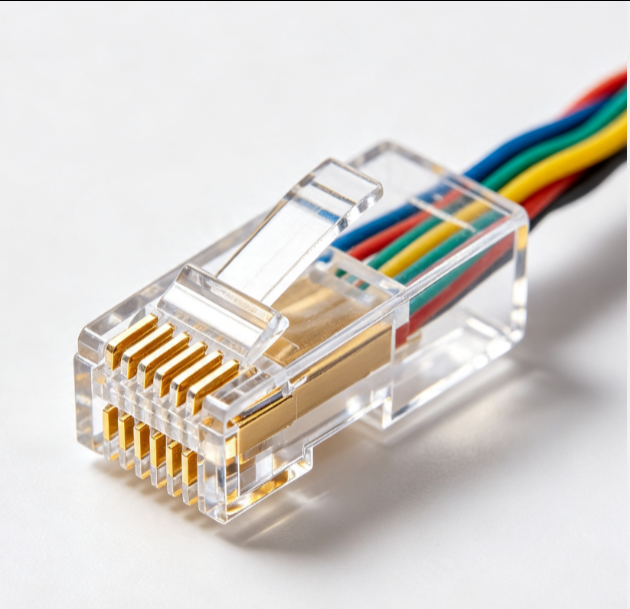
Construction process adaptation gives full play to the structural advantages of cat7 pass through connectors, reducing the construction threshold and fault probability of high-speed wiring. When crimping traditional closed crystal connectors, core wires are hidden inside, making it impossible to visually check arrangement, bending and extrusion conditions, which easily causes hidden faults such as wrong wire sequence, insufficient crimping and broken shielding layers with difficult troubleshooting. In contrast, the through penetrating design of cat7 pass through connectors allows eight core wires to completely penetrate the front end of the connector, enabling constructors to intuitively inspect wire sequence arrangement, core wire flatness and shielding layer fitting degree, fundamentally eliminating wiring process defects and greatly improving the construction qualification rate of CAT7 network cables. Compatible with standard RJ45 crimping pliers without special tools, the connectors adapt to general mainstream construction equipment, featuring simple and efficient construction procedures and suitable for large-scale construction scenarios such as batch computer room wiring, park integrated wiring and high-end whole-house networking. They adapt to both long-distance and short-distance wiring processes, maintaining stable adaptation for short-distance equipment jumpers and long-distance embedded wiring. The penetrating structure can effectively buffer stress damage caused by line pulling and bending, improving the durability and stability of finished wiring. In terms of construction adaptation, CAT7 wire sequencing standards must be strictly followed, matched with special shielding tail clamps and waterproof and dustproof rubber sleeves to ensure complete fitting of shielding layers and realize perfect adaptation of technology and accessories.
Multi-scenario working condition adaptation reflects the broad-spectrum adaptation capability of cat7 pass through connectors, adapting to various complex network operation environments. In data center computer room scenarios with densely distributed equipment and numerous electromagnetic devices causing strong signal interference, the full metal shielding structure can effectively resist complex electromagnetic interference in the computer room, adapting to high-intensity working conditions such as server cluster operation, switch stacking and high-speed data transmission, ensuring stable transceiving of 10G data without packet loss or delay. In enterprise office and intelligent building scenarios, they adapt to working conditions such as multi-terminal online operation, high-frequency file transmission, video conferences and cloud office, stably bearing high-bandwidth and high-concurrency network demands to avoid network congestion and stuttering. In security monitoring scenarios, they adapt to 4K/8K high-definition camera operation, multi-channel synchronous video transmission and 24-hour uninterrupted operation, ensuring real-time transmission of monitoring images without delay or interruption by virtue of low-loss and high-stability characteristics. In high-end home and e-sports networking scenarios, they meet the demands of high-speed broadband, cloud gaming, 4K audio and video transmission and multi-device linkage, fully releasing the 10G bandwidth potential of CAT7 network cables. Meanwhile, their wide temperature adaptation, aging resistance and wear resistance enable adaptation to multiple environmental working conditions such as indoor normal temperature, outdoor ventilation and closed high temperature in cabinets, ensuring stable operation throughout the four seasons and covering all commercial, civil and industrial high-speed network scenarios.
System compatibility adaptation is the key to ensuring unified full-link network performance and avoiding bottleneck loss. A compliant high-speed network system requires consistent parameters of network cables, connectors, patch panels, switches and terminal equipment; mismatched single accessories will directly lead to overall speed downgrade. cat7 pass through connectors are perfectly compatible with complete sets of CAT7 wiring accessories, including CAT7 shielded patch panels, shielded panels, shielded jumpers and grounding modules, forming a full-link shielding closed loop and unified parameters to prevent signal attenuation and excessive interference caused by incompatible accessories. They support smooth upgrading and transition of new and old network systems, compatible with Category 6 and 6A wiring systems as well as Gigabit and 10G equipment, enabling network upgrading without overall equipment replacement and greatly reducing renovation costs. In terms of long-term operation and maintenance adaptation, the connectors feature stable structure, long plugging life and excellent anti-aging performance, adapting to the long-term uninterrupted network operation and reducing later-stage troubleshooting and accessory replacement costs. In summary, with full-dimensional, high-precision and wide-scenario adaptation advantages, cat7 pass through connectors completely solve the industry pain point that traditional network accessories cannot adapt to CAT7 10G wiring. As the accessory with the strongest adaptability, highest stability and best landing performance in current high-end integrated wiring projects, they provide core adaptation support for the compliant construction, stable operation and long-term upgrading of various high-speed network systems.
-

-

-

-

-

-

-

-

-

-

Dustproof Cover Equipped Network Patch Panel
Oct 10, 20261117
-

How to wire a French switch outlet
Oct 28, 20261112
-

Network Cable Break Point Detector Tester
Oct 09, 20261089
-

Cat6 Lan Cable Length Limit for Gigabit
Oct 24, 20261085
-
RJ45 Connector Cat6 for DIY Cable Making
Nov 20, 20261032