- Language
cat8 SFTP patch cable
In high-density data centers, server rack interconnections, high-performance computing clusters and direct links between storage arrays, continuous transmission of large datasets raises new requirements for the transmission performance of copper cabling. As 25G and 40G Ethernet devices are increasingly deployed, the bandwidth limits of traditional Cat6 and Cat6A cables can no longer support stable transmission of heavy traffic. Compliant finished shielded patch cords under category 8 specifications, supported by high bandwidth and rigorous shielding construction, serve as vital interconnection components within short-range high-speed links and facilitate mass data exchange between switches, servers and storage hardware inside server rooms.
In terms of transmission metrics, this cabling standard offers a rated bandwidth of 2000 MHz, a substantial upgrade compared with Cat6A. Ample frequency headroom forms the foundation for 25GBASE-T and 40GBASE-T transmission. The standard defines a clear channel length boundary: the total channel length is capped at 30 meters, which marks the stable operating limit for high-frequency signals over twisted-pair copper. High-frequency signals are far more susceptible to attenuation, crosstalk and coupled electromagnetic interference. For this reason, the category 8 standard mandates shielded construction. Composite shielding simultaneously suppresses internal pair crosstalk and external electromagnetic noise, preserving waveform integrity at high frequencies and lowering transmission anomalies including bit errors, packet loss and speed fluctuation.
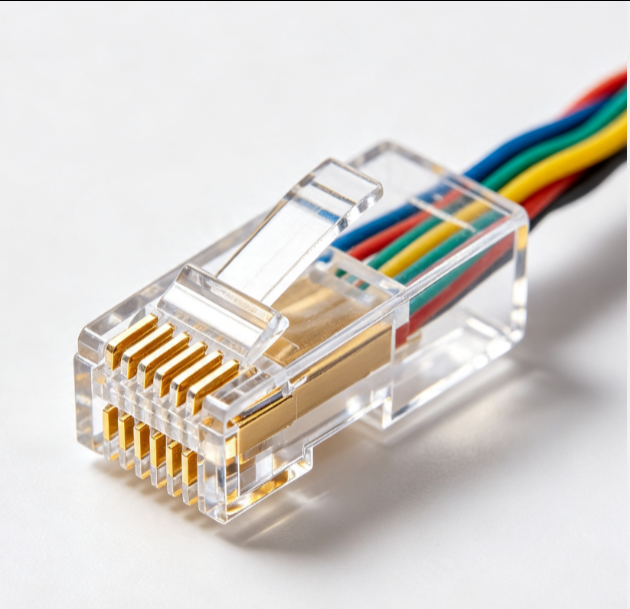
Its composite shielding architecture underpins reliable high-speed transmission. Each of the four twisted pairs inside the cable is individually wrapped with foil shielding to control near-end and far-end crosstalk between pairs. A metal braided mesh covers all pairs as an overall screen to create dual-layer protection. Foil layers excel at isolating high-frequency radio interference, while braided shielding delivers greater mechanical toughness and resists breakage during repeated bending and cable management, sustaining an uninterrupted shielding path. At 2000 MHz, any discontinuity in shielding will introduce noise and erode transmission margin, which differentiates it sharply from lower-grade shielded cables. Internal conductors are mostly stranded copper, balancing conductive efficiency and flexibility for frequent plugging and port rearrangement inside racks. Low-loss foamed polyethylene insulation reduces dielectric loss during high-frequency signal delivery and keeps attenuation within specification limits. Outer jackets are available in PVC and LSZH variants; LSZH versions suit fire regulation requirements in enclosed server rooms and underground communication ducts. Shielded RJ45 connectors are fitted at both ends. The metal shell maintains 360-degree continuous electrical contact with the cable shield, and gold-plated contacts stabilise contact resistance through repeated mating cycles to prevent intermittent communication fluctuations during high-speed transmission.
High-speed links are highly sensitive to channel integrity, and the maximum transmission throughput of the whole channel is bounded by its weakest component. Many server room renovation projects invest heavily in upgrading shielded permanent backbone links while overlooking matching patch cord grades. Even if fixed backbone cabling meets Cat8 benchmarks, poorly specified patch cords with substandard shielding, inaccurate twist geometry or inadequate termination introduce extra attenuation and crosstalk at the patch point. This prevents the full 25G or 40G speed from being realised and wastes the performance investment in backbone infrastructure. As replaceable movable components, patch cords must be validated with specialised testers for insertion loss, return loss, crosstalk metrics and shielding continuity before being deployed for high-speed workloads.
Besides high-speed data services, they also support PoE++ power delivery. Data and high-power supply travel over the same conductors, supporting power delivery up to 100 watts. This feature simplifies dense rack layouts, allowing storage nodes, high-speed wireless units and remote computing endpoints to operate without separate power cabling. Backward compatibility is also retained, supporting legacy 10G, gigabit and 100-megabit Ethernet seamlessly. During phased upgrades with mixed old and new hardware, full endpoint replacement is unnecessary, enabling a smooth network evolution path.
Consistent high-speed transmission relies on proper installation and earthing, a frequently overlooked requirement for Cat8 shielded cabling. Shielding only works effectively when it forms a continuous conductive path connected to reliable earth, diverting induced electromagnetic noise to ground. Poor connector earthing or differing earth potentials at separate grounding points create ground loops, inducing circulating noise across the shield and degrading high-frequency signal quality. A unified earthing layout is required during deployment to maintain conductivity between shielded patch panel modules, patch cord shells and rack grounding buses, with earth resistance meeting cabling standards. Routing must respect the minimum bend radius; sharp folds and heavy compression are forbidden, as they may rupture internal foil shielding and distort pair twist geometry. Adequate clearance must be maintained between data cables and power conductors to reduce electromagnetic coupling. Connectors should be gripped by their shielded housing rather than pulled by the cable jacket, to avoid conductor deformation and shield fracture. Colour coding and labelling within racks simplify fault isolation, port reconfiguration and future expansion. Dust caps on unused ports protect contacts from dust and oxidation and preserve stable electrical contact.
Application scenarios focus primarily on short-distance, high-throughput interconnections inside data rooms. Direct links between servers and top-of-rack switches, connections within storage clusters, jumpers between high-speed switches and links from high-performance workstations to core network hardware are typical use cases. Workloads such as file mirroring, distributed storage reads and writes, virtual machine migration and real-time scheduling of computing resources generate persistent heavy traffic that demands strict bandwidth and latency stability. Minor signal disturbances may trigger service stalling or task interruption. Standard offices and long-distance deployments have no requirement for 40G transmission, and lower-grade cabling is sufficient without extra investment in high-performance components.
Looking ahead to medium and long-term data centre upgrades, 25G and 40G Ethernet represent the mainstream direction for computing network evolution. These patch cords match next-generation high-speed switches, network adapters and storage hardware, enabling underlying links built for high-speed transmission in advance. This extends the service life of network infrastructure and avoids repeated recabling within short cycles. Amid expanding computing workloads, stable high-speed copper interconnections offer a low-cost, plug-and-play supplement to fibre links.
In summary, the core advantage of category 8 composite shielded patch cords lies in enabling stable high-bandwidth transmission within defined length limits. Its transmission performance does not depend on conductor material alone, but is a combined outcome of bandwidth rating, precision pair twisting, dual shielding, continuous screening paths and compliant earthing. When building high-speed local networks for data centres, selection should consider endpoint port standards, total channel length, on-site electromagnetic conditions and earthing infrastructure. Professional channel testing confirms attenuation, crosstalk and other indicators are within tolerance, unlocking the full transmission potential of high-speed Ethernet and establishing low-latency, low-bit-error interconnection pathways capable of carrying massive traffic volumes.
-

-

-

-

-

-

-

-

-

-

Dustproof Cover Equipped Network Patch Panel
Oct 10, 20261117
-

How to wire a French switch outlet
Oct 28, 20261112
-

Network Cable Break Point Detector Tester
Oct 09, 20261089
-

Cat6 Lan Cable Length Limit for Gigabit
Oct 24, 20261085
-
RJ45 Connector Cat6 for DIY Cable Making
Nov 20, 20261032