- Language
cat8 ethernet cable 1m:Operation and Maintenance Guidelines for 1-Meter Category 8 Ethernet Cable
A 1m Cat8 Ethernet patch cable is a widely used short fully shielded factory-terminated twisted pair in data center operation and maintenance. It complies with ANSI/TIA-568.2-D and ISO 11801 standards, delivers 2000 MHz bandwidth and supports 25GBASE-T and 40GBASE-T copper Ethernet while remaining backward compatible with 10G and Gigabit networks. Cat8 mandates S/FTP full shielding: each twisted pair is individually wrapped with aluminium foil, and an outer metal braided screen covers the whole bundle. No unshielded Cat8 cable is officially compliant. The standard caps the total Cat8 channel length at 30 meters including all patch cords. The 1m variant is mainly deployed for short-range connections between switches, servers, high-speed NAS and storage arrays within the same rack. It serves as a fundamental spare component for high-density data center maintenance, link reconfiguration and fault replacement. O&M engineers must master Cat8 physical characteristics, earthing specifications, routine inspection, fault localization and spare parts management to sustain stable 25G/40G high-speed copper links.
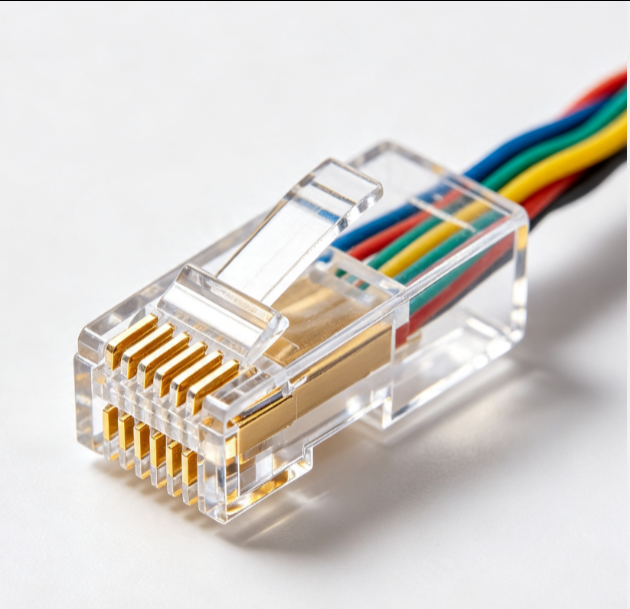
From an O&M perspective, the structural features of the 1m Cat8 patch cable define maintenance strategies. The cable uses stranded oxygen-free soft copper conductors. Unlike solid copper used for permanent in-wall cabling, stranded copper offers better flexibility for repeated plugging and port reconfiguration, yet its high-frequency performance is highly vulnerable to mechanical damage. The four twisted pairs maintain precise twist rates. At the ultra-high frequency of 2000 MHz, minor twist stretching or bending deformation causes impedance discontinuity and excessive crosstalk. Factory-fitted shielded metal RJ45 plugs require continuous electrical continuity between the cable shield, drain wire and plug metal shell. Any break in the shielding path will void the Cat8 shielding performance. Jacket options are PVC and LSZH. LSZH is preferred in enclosed rack rooms; it releases less toxic smoke in fire events and meets data center fire safety requirements. Most plugs come with snagless boots to reduce latch breakage after repeated insertion and removal and minimize unplanned outages. The 1m short length avoids slack cable coiling and stacking, which reduces alien crosstalk, eases cable management and prevents airflow blockage, making it ideal for intra-rack short-distance interconnection in high-density environments.
For on-site deployment in data center O&M, shield earthing is the top priority and a common source of faults. Cat8 belongs to a fully shielded structured cabling system. A shielded patch cord cannot work independently. The entire channel must include shielded patch panels and shielded keystone jacks, with reliable equipotential earthing at both ends of the shielding system. Frequent O&M mistakes include single-point grounding, poor earthing contact and inconsistent ground potential between two ends, which create ground loops and introduce electromagnetic noise, resulting in packet loss and link jitter. After earthing installation, O&M teams must test shield continuity and ground potential to verify valid equipotential bonding. In addition, Cat8 imposes strict cable management rules. Even for a short 1m patch cord, heavy tight bundling is prohibited. Dense bundling increases alien crosstalk. The 2000 MHz high-frequency signal is extremely sensitive to crosstalk; a physically good cable may still fail channel certification due to poor routing. Sharp right-angle bends are forbidden at turning points. Bend radius must meet cable specifications to preserve original pair twist. When plugging or unplugging, technicians must grip the connector boot instead of pulling directly on the cable jacket. Pulling the jacket may fracture conductors at the plug root and trigger intermittent hard-to-reproduce faults.
Routine inspection and periodic maintenance form the standard workflow to preserve Cat8 link stability. Core checklist items include visual inspection for jacket cuts, crushing damage, ageing cracks, oxidation or corrosion on metal plug shells; physical connectivity checks to confirm fully seated RJ45 connectors, intact latches and no loose contacts; cable routing review to avoid over-compression and tight bundling and guarantee unobstructed rack airflow; periodic re-verification of earthing to check for loose or corroded ground terminals and sustained equipotential bonding. Quarterly sampling certification tests are recommended for business-critical Cat8 links using a Level 2G cable certifier supporting 2000 MHz. Key parameters including insertion loss, return loss, near-end crosstalk and alien crosstalk are measured and baseline records stored. Any degradation against the baseline triggers cable replacement in advance to prevent service disruption. Labelling management is also essential. Different colours of 1m Cat8 patch cords separate service types, for example red for storage links and blue for server links. Labels mark port information at both ends to accelerate localization during migration, cutover and troubleshooting and reduce O&M time.
Spare parts management and change control are integral parts of data center O&M systems. 1m Cat8 patch cords are frequently used spares. The spare warehouse should maintain adequate stock of matched cables. Sampling channel tests must be completed before new stock enters inventory to prevent substandard cables from being deployed in production. During acceptance, procurement teams should not rely solely on printed jacket markings. Conductor material, AWG gauge and official test reports need validation. High-purity oxygen-free copper is preferred. Copper-clad aluminium or copper-clad steel alternatives have high DC resistance, severe high-frequency attenuation, frequent packet loss in 25G/40G links and overheating risks under high-current PoE++ loads. For network cutover, port migration and server installation/removal, back-up must be completed before changes. Cat8 cables are handled gently during rework. After physical reconnection, link connectivity and speed verification confirm stable 25G/40G negotiation before traffic cutover. Change records are archived with replacement time, location and test results to build complete O&M logs. Engineers must calculate total channel length: the full Cat8 channel includes both patch cords and permanent cabling and must not exceed the 30-meter hard limit. If permanent cabling is overlong, even qualified 1m Cat8 patch cords cannot sustain full high-speed throughput. Many O&M faults stem from exceeding this total channel length limit.
Fault troubleshooting is a core Cat8 O&M skill. High-speed copper faults fall into hard failures and intermittent hidden faults. Hard failures include total link outages and port down events. The troubleshooting sequence checks switch port indicators, reseats connectors and performs cross-testing by substituting a known-good 1m Cat8 patch cord to isolate faults to the patch cord, port or backend cabling. Intermittent faults feature random packet loss, link flapping and unstable speed negotiation and are harder to diagnose. Root causes commonly include poor shield contact at plugs, defective earthing, internal micro-fractures of conductors, over-tight bundling and electromagnetic interference from high-power adjacent equipment. Troubleshooting steps isolate EMI sources away from inverters and power cables, inspect cable bending and bundling and run full parameter certification tests compared with baseline data. A widespread misconception must be clarified: replacing only both-end Cat8 patch cords while leaving intermediate horizontal cabling as unshielded generic wiring cannot achieve Cat8 channel performance and will fail certification. Simply swapping patch cords does not upgrade an inadequate channel. If channel metrics remain out of specification, replace the pre-terminated patch cord directly instead of field re-crimping; factory-terminated Cat8 cords deliver far more stable termination quality than hand-crimped plugs.
O&M teams should also maintain clear technical boundaries and rational resource planning. Cat8 is only designed for short-reach high-speed copper transmission within 30 meters. Fiber optics is the proper choice for long-distance high-speed services; extending links via Cat8 patch cords should be avoided. For services requiring no more than 10G, Cat6A is fully sufficient, eliminating the higher cost and complexity of Cat8 deployment. Cat8 supports IEEE 802.3bt PoE++ up to 100W. O&M inspections should simultaneously monitor current and temperature on PoE-enabled Cat8 links and respond promptly to anomalies.
In summary, the 1m Cat8 Ethernet patch cable is a compact yet critical component for high-speed copper link O&M in data centers. O&M covers pre-deployment acceptance, rack installation, earthing and cable routing control, periodic inspection, spare inventory, change management and standardized troubleshooting, not merely cable performance. Cat8 is far more sensitive to workmanship, earthing and mechanical stress than Cat6 or Cat6A. Most high-speed link faults arise not from defective cables themselves, but improper O&M operations, failed earthing and poor routing. Standardized O&M workflows, periodic link certification and controlled spare and label management reduce fault frequency, guarantee stable 25G/40G traffic between servers and storage arrays, and mitigate losses caused by unexpected service interruptions.
-

-

-

-

-

-

-

-

-

-

Dustproof Cover Equipped Network Patch Panel
Oct 10, 20261117
-

How to wire a French switch outlet
Oct 28, 20261112
-

Network Cable Break Point Detector Tester
Oct 09, 20261089
-

Cat6 Lan Cable Length Limit for Gigabit
Oct 24, 20261085
-
RJ45 Connector Cat6 for DIY Cable Making
Nov 20, 20261032