- Language
cat8 ethernet cable
A Cat8 ethernet cable is a copper transmission medium designed for 25G and 40GBASE-T high-speed links, supporting bandwidth up to 2000 MHz. Its fundamental distinction from Cat6A and Cat7 lies not in printed speed ratings, but in a full cable architecture optimized for impedance, crosstalk and return loss at ultra-high frequencies. Cat8 mandates an S/FTP double-shielded construction, where every structural layer serves a defined signal-protection purpose. Cutting corners on any component degrades high-frequency performance sharply. Many buyers rely only on outer Cat8 labelling without inspecting internal build quality, and may receive under-shielded, poorly paired cables that trigger instability and certification failures after deployment in data centres.
The innermost layer consists of conductors and insulation. Two conductor styles are widely adopted: solid bare copper for fixed horizontal permanent runs, commonly 22AWG or 23AWG for consistent impedance over long static installation, and stranded copper for patch cords, typically 24AWG or 26AWG for flexibility under repeated plugging and bending. Compliant variants use high-purity oxygen-free copper. Copper-clad alternatives have elevated DC resistance and worse high-frequency insertion loss, with decay becoming pronounced at 2000 MHz. Each conductor is wrapped in skin-foam-skin high-density polyethylene insulation. The foamed core lowers dielectric constant to stabilize impedance, while the solid outer skin adds mechanical protection. Uniform insulation thickness and concentricity are required; eccentricity creates impedance fluctuations and return loss faults.
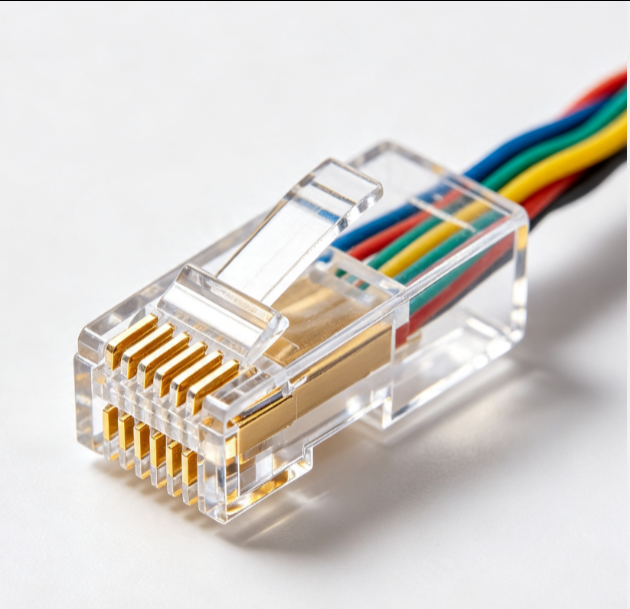
Four twisted pairs form the signal-carrying core, and twist geometry controls crosstalk. The four pairs follow standard colour coding: blue-white, orange-white, green-white and brown-white. Each pair runs at a unique twist pitch to cancel mutual electromagnetic coupling. Twist rates must remain consistent during manufacturing; over-stretching straightens pairs and breaks the interference-cancelling mechanism. High-frequency signals are extremely sensitive to untwisted length at RJ45 terminations, and excessive untwisting ranks as the top reason for Cat8 certification failure. The four pairs remain separate and are never randomly interwoven, so each can be enclosed by its dedicated foil shield.
Inner shielding is implemented as individual foil wrapping for every pair, the first critical barrier in the S/FTP design. Each twisted pair is enclosed by aluminium-polyester laminate foil with near-full coverage to suppress near-end and far-end crosstalk between pairs. At 2000 MHz, inter-pair coupling rises rapidly; removing individual foil and relying only on an overall outer screen cannot contain crosstalk within standard limits. A tinned-copper drain wire runs alongside each foil, bleeding induced charge away and stabilizing shield potential. Reliable continuous contact between drain wire and foil must be maintained.
An overall copper braided screen wraps the complete bundle of four individually shielded pairs to form the second protective layer. The braid uses tinned copper wires with a specified minimum coverage ratio, often above 60% and up to roughly 85% on premium grades. Foil excels at high-frequency crosstalk suppression while the braid provides stronger immunity to low-frequency electromagnetic and radio interference, in addition to improved crush and tear resistance. Both shielding layers must remain continuous. During termination, foil, braid and drain wire need full 360-degree bonding to the metal shielded plug shell. Any discontinuity breaks the shielding loop and allows interference to penetrate the channel.
A separator or filler may be inserted between shielded pairs in some designs. Cross frames or insulating spacers hold pairs apart, preventing deformation under compression and preserving geometry. Low-loss dielectric compounds are used so the filler does not introduce signal distortion. Separators are more common in bulk trunk cables; many thinner patch cords omit them and rely on jacket tension for internal fixation.
The outermost jacket comes in two dominant formulations: PVC and LSZH. PVC delivers good flexibility at moderate cost for standard server rooms and office cabling. LSZH releases minimal smoke and no halogens during combustion, complying with fire codes for enclosed data centres and public risers. Jackets must resist ageing, oil and low temperature. Low-grade recycled jackets turn brittle after bending or UV exposure and crack easily; ingress of moisture and dust breaks shielding continuity. A ripcord is sometimes embedded inside the jacket to enable clean stripping without damaging internal shielding and pairs.
A Cat8 ethernet cable works as an integrated structural system: conductors, foam insulation, differentiated twist pitches, individual foil screens, overall braided shielding and outer jacket operate together. Its stiffer construction demands a larger minimum bend radius than lower-category cables. Sharp folding or crushing fractures aluminium foil and destroys screening. Acceptance testing should go beyond simple link verification. Internal shielding inspection and full channel validation with a cable analyser, checking attenuation, crosstalk and impedance, are recommended. Understanding this layered architecture helps distinguish genuine Cat8 cable from reduced-specification substitutes and sustains stable 40G operation.
-

-

-

-

-

-

-

-

-

-

Dustproof Cover Equipped Network Patch Panel
Oct 10, 20261117
-

How to wire a French switch outlet
Oct 28, 20261112
-

Network Cable Break Point Detector Tester
Oct 09, 20261089
-

Cat6 Lan Cable Length Limit for Gigabit
Oct 24, 20261085
-
RJ45 Connector Cat6 for DIY Cable Making
Nov 20, 20261032