- Language
cat8 patch cable 1m
The 1m Cat8 patch cable is a high-performance network patch cord built for short-distance interconnections inside high-density server racks, supporting bandwidth up to 2000 MHz and 40GBASE-T Ethernet, while remaining backward compatible with 10G, Gigabit and lower-speed networks. Its core difference from lower-category cables lies not in its length, but in the high-frequency-oriented shielding design, termination craftsmanship and impedance control. Many buyers mistakenly believe short cables tolerate looser manufacturing standards and rely only on Cat8 labelling. Hidden defects can cause packet loss, unstable link negotiation and failed channel certification once high-speed services go live.
Cat8 mandates S/FTP double shielding. Each of the four twisted pairs is individually wrapped with aluminium foil to isolate pair-to-pair crosstalk, and an outer copper braided screen covers the whole cable to block external electromagnetic interference and limit signal radiation. This foil-per-pair plus overall braid construction is essential for stable transmission at 2000 MHz, and the requirement does not relax for shorter patch cords. Many low-cost alternatives cut corners by removing individual foil wraps and retaining only the outer braid. They may pass basic link tests but suffer rising crosstalk and bit errors under sustained 25G or 40G traffic and fail formal channel certification.
Conductors are typically stranded 24AWG or 26AWG high-purity oxygen-free copper. Stranded wiring delivers better flexibility for frequent re-patching and cable rearrangement in server rooms. Inferior cables substitute pure copper with copper-clad aluminium or copper-clad steel, which bring higher DC resistance and high-frequency insertion loss. Even at just one metre, sustained heavy traffic leads to gradual performance degradation. The four twisted pairs use unique twist pitches to reduce signal coupling. Untwisted length at the RJ45 plug must be strictly limited; excessive untwisting distorts the twist geometry and ranks as the leading cause of Cat8 certification failure.
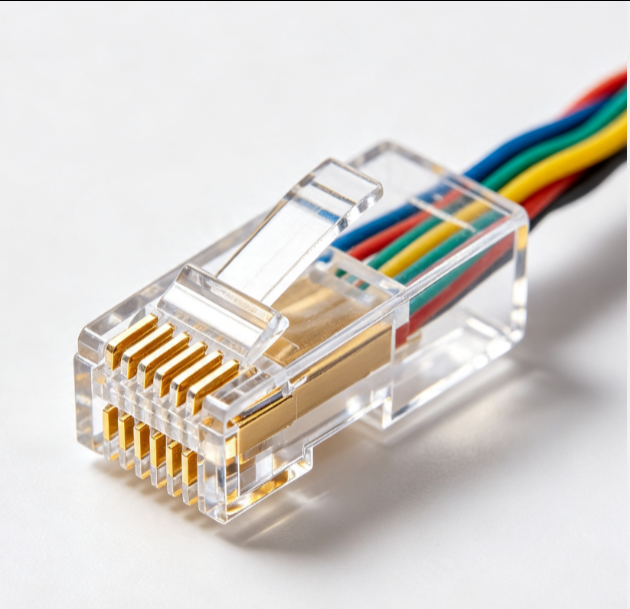
Shielded RJ45 plugs are critical to overall performance. Compliant Cat8 patch cables feature solid metal plug shells, with the cable’s internal shield and drain wire making full 360-degree contact to maintain an uninterrupted shielding path. Any breakage invalidates the whole shielding system. Gold-plated contact pins resist oxidation and deliver stable connectivity through repeated mating cycles. Snagless boots and integrated strain relief protect the junction between cable and plug, preventing conductor and shield breakage from repeated bending and pulling. Most patch-cable faults in server environments occur at this transition point, and products without proper strain relief have far shorter service life.
Two common jacket options are available: PVC and LSZH. PVC offers good flexibility at moderate cost for standard enterprise server rooms. LSZH jackets produce low smoke and zero halogens during combustion, complying with fire regulations for enclosed data centres and public communications closets. Jacket quality affects long-term reliability. Recycled compound jackets tend to crack after repeated flexing, letting dust and moisture break shielding continuity and corrupt high-frequency signals.
Under the Cat8 channel model, the total maximum channel length is 30 metres, combining permanent horizontal cabling plus patch cords at both ends. The 1m variant provides generous performance headroom and suits top-of-rack architectures. Servers, switches and storage nodes within one cabinet sit close together, so 1m patch cables eliminate unnecessary coiling. Excess coiling forces tight bends that tear foil shielding and block rack airflow, raising equipment operating temperatures. Careful deployment of short patch cords tidies cable routing and improves thermal conditions for easier maintenance.
Despite its short in-rack use case, installation rules still apply. First, consistent grounding potential is required at both ends of the shielded cable; ground potential difference creates common-mode noise that penetrates the shield and causes network fluctuation. Second, minimum bend-radius limits must be followed, and over-tight bundling should be avoided. Third, certified Cat8 patch cables support PoE++, but undersized conductors in low-grade cords overheat under long-duration high-power supply.
Acceptance testing should go beyond simple connectivity checks. Professional cable analysers validate attenuation, crosstalk, return loss, impedance and other high-frequency parameters. Bulk procurement reviews should verify shielding type, conductor grade and termination quality alongside datasheet figures. The 1m Cat8 patch cable is engineered to deliver reliable 25G and 40G interconnections inside compact racks. It is not merely a short version of ordinary network cable, but a high-speed component with strict standards for shielding, construction and termination. Reliable high-speed links depend directly on consistent patch-cable quality.
-

-

-

-

-

-

-

-

-

-

Dustproof Cover Equipped Network Patch Panel
Oct 10, 20261117
-

How to wire a French switch outlet
Oct 28, 20261112
-

Network Cable Break Point Detector Tester
Oct 09, 20261089
-

Cat6 Lan Cable Length Limit for Gigabit
Oct 24, 20261085
-
RJ45 Connector Cat6 for DIY Cable Making
Nov 20, 20261032