- Language
cat8 patch leads 3m
3-metre Cat8 patch leads are widely deployed as short high-speed copper components in dense data centre and server-room cabling. Unlike generic lower-grade network cables, their entire construction is engineered for 2000 MHz bandwidth and 40GBASE-T transmission. Shielding layout, twist pitch, termination and jacket protection all follow stringent specifications. Many buyers only check speed labelling while overlooking structural differences. Two cables both marked Cat8 may still fail channel certification, suffer excessive crosstalk or become unstable after long use. Understanding its internal architecture supports proper selection, inspection and cabling planning.
Cat8 requires mandatory S/FTP double shielding, the primary distinction from Cat6A and Cat7. Each of the four twisted pairs is individually wrapped with aluminium foil to isolate pair-to-pair crosstalk. An overall copper braided shield covers the whole cable, blocking external electromagnetic and radio-frequency interference while limiting outgoing radiation. This combined foil-per-pair plus overall braid design is essential for stable transmission at 2000 MHz. Simplified shielding, such as a single overall shield without individual foil wraps, struggles to control near-end and far-end crosstalk at high frequencies. It may link up briefly but trigger packet loss and high bit error rates under heavy high-bandwidth load. The 3-metre length is a standard patch lead size for Cat8 channels. Typical permanent link setups use two 3 m patch cords, keeping the total channel within the 30 m limit defined for 40G twisted-pair Ethernet.
Controlled twist pitch of the four pairs is another critical structural feature. To minimise coupling interference, each pair is twisted at a unique, consistent rate. Poor-quality products over-strip shielding and straighten twisted wires during RJ45 termination, disrupting the original twist geometry and degrading performance. Cat8 imposes much tighter limits on untwisted length at terminations than lower categories; excessive untwisting is the top cause of failed certification tests. Conductors are usually 24AWG or 26AWG high-purity oxygen-free copper. Alternatives such as copper-clad aluminium or copper-clad steel raise DC resistance and high-frequency insertion loss, leading to gradual performance drop under sustained high-speed traffic.
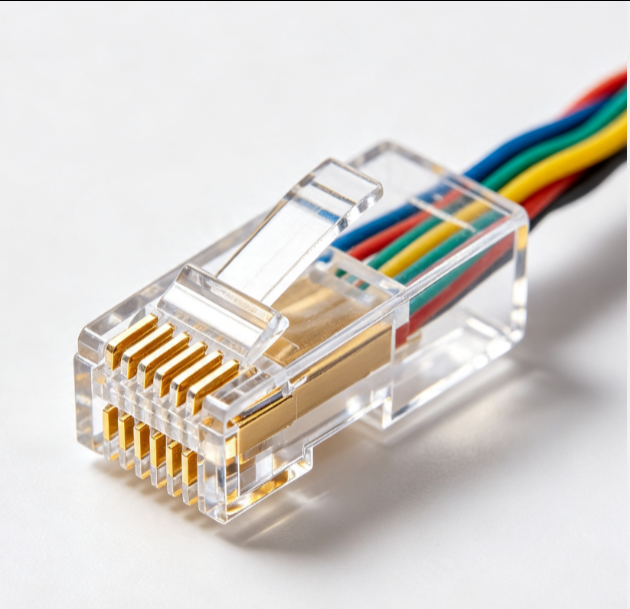
RJ45 connectors and strain relief are easily overlooked external structures. Compliant Cat8 plugs have fully shielded metal shells bonded reliably to the cable’s internal shielding to form a continuous shielding enclosure. Contact pins are gold-plated, commonly around 50 microns thick, to maintain stable connection through repeated mating cycles and resist oxidation. Most versions integrate snagless boot covers and flexible strain-relief tails to prevent conductor breakage and shield disconnection at the cable-plug junction during repeated bending, pulling and cable management. In server rooms with frequent re-patching, leads without proper strain relief often develop intermittent connectivity first.
Two dominant jacket types are available: PVC and LSZH. PVC offers good flexibility at moderate cost for ordinary server rooms. LSZH formulations release low smoke and contain minimal halogens during combustion, preferred in enclosed cabinets and public facilities with strict fire safety rules. Jackets must resist ageing, oil and low temperature. Thin or recycled-compound jackets crack easily under repeated flexing, letting dust or moisture break the shielding continuity.
Its structure also defines operational limits. The double-shielded design makes Cat8 stiffer; sharp bends or crushing must be avoided, as tight radii tear foil and braid and break the shield path. Consistent earthing of the shield at both ends is also required. Earth potential differences introduce common-mode noise and cause network anomalies.
The performance of a 3 m Cat8 patch lead relies on its full structural system: individual foil shielding plus overall braid, accurately controlled twist pitch, high-grade copper conductors, fully shielded RJ45 termination, robust strain relief and durable outer jacket. Procurement checks should go beyond printed labels and verify shielding continuity, untwisted length and conductor material. Channel validation with cable analysers is recommended. Only construction-compliant leads can sustain stable 25G and 40G Ethernet interconnections between switches and servers inside data centres over extended periods.
-

-

-

-

-

-

-

-

-

-

Dustproof Cover Equipped Network Patch Panel
Oct 10, 20261117
-

How to wire a French switch outlet
Oct 28, 20261112
-

Network Cable Break Point Detector Tester
Oct 09, 20261089
-

Cat6 Lan Cable Length Limit for Gigabit
Oct 24, 20261085
-
RJ45 Connector Cat6 for DIY Cable Making
Nov 20, 20261032