- Language
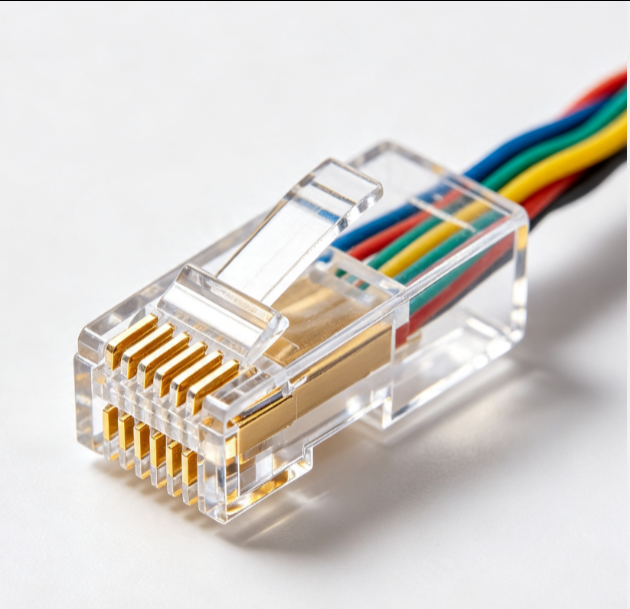
category 6a patch cable
In modern network engineering wiring, intensive computer room networking, commercial building weak current renovation and whole-house smart decoration scenarios, the bending angle adaptability and damage resistance of network cables directly determine the success rate of network construction, wiring aesthetics and long-term operation stability. Most ordinary network cables have thin structures and insufficient toughness with poor angle compatibility. When facing complex working conditions such as corner turning, gap routing and circuitous wiring on construction sites, they are prone to skin tearing, bent core damage and internal structure dislocation. Once hidden damage occurs to the cable, it will not cause immediate network disconnection, but will continuously trigger hidden faults such as signal crosstalk, transmission packet loss and network speed attenuation, bringing great difficulty to later troubleshooting and greatly increasing maintenance and rework costs. As an engineering-grade Category 6A jumper, the category 6a patch cable takes multi-angle wiring adaptation and all-round damage-resistant structure as its core selling points. It starts with solving the pain points of wiring angles, thoroughly resolving the industry problems of traditional cables such as easy breakage, limited angles, undetectable damage and short service life, and provides a highly adaptable, damage-resistant and high-stable professional networking solution for full-scenario network wiring.
Poor wiring angle adaptability is the main cause of cable damage during construction. Traditional conventional network cables adopt hard outer sheaths and loose stranding technology with extremely low bending tolerance, only supporting simple straight wiring. In actual engineering construction, scenarios such as intensive cable management in cabinets, internal and external wall corner turning, narrow interlayer wiring in ceilings, equipment wall-mounted installation and hidden wiring under furniture require multi-angle bending, arc circuitous routing and close-fitting wiring of network cables. Forced 90-degree right-angle hard bending, multiple reverse twisting and extrusion fitting of ordinary cables will lead to irreversible damage such as outer skin cracking, sheath breakage, internal pairing dislocation and shielding layer fracture. Most hidden damage is invisible to the naked eye with no abnormalities during wiring acceptance. However, after long-term electrified operation, dust accumulation, moisture and oxidation will occur at the damaged positions, gradually causing network stuttering, intermittent disconnection and 10-gigabit speed reduction, becoming long-term hidden dangers in network engineering. With dual upgrades of materials and structure, the category 6a patch cable has extremely strong multi-angle compatibility, fundamentally avoiding cable damage caused by forced bending.
Adopting high-elastic flexible environmentally friendly outer sheath and precise symmetrical stranding technology, the category 6a patch cable features soft cable body with balanced support, eliminating the stiff and brittle defects of traditional cables. It supports 360-degree full-angle free wiring, including 90-degree right-angle close-fitting regular wiring, 180-degree folding storage, arc circuitous wiring and twisted threading in narrow gaps. It can naturally fit various scene angles without forced extrusion or violent bending, ensuring uniform cable stress and no local stress concentration leading to cracking and damage. The product has passed tens of thousands of multi-angle cyclic bending fatigue tests. After repeated twisting, bending and storage, the outer skin remains intact without cracking, the core alignment is not offset, the shielding structure is not damaged, and the internal cavity does not collapse. It perfectly adapts to various complex and special-shaped wiring scenarios, realizing construction at any angle without wire damage and eliminating hidden line damage from the construction source.
In addition to the advantage of multi-angle damage-resistant wiring, the category 6a patch cable is equipped with a thickened damage-resistant protective architecture, which comprehensively resists physical damage caused by construction friction, pulling, rolling and wear, and further strengthens the integrity of the line. Traditional network cables have thin and fragile outer skins, which are easily scratched and damaged by pipe burrs, wall edges and metal brackets during construction threading, dragging and fixing. Slight wear will destroy the line tightness. This Category 6A jumper adopts a thickened wear-resistant outer sheath, together with a multi-layer composite structure of inner insulation protection and middle shielding protection, which greatly improves the overall tensile, friction and extrusion resistance. No skin breakage, wear or cracking will occur during construction threading and dragging, cabinet extrusion and daily friction. The integrated multi-layer protective structure firmly locks the internal cores and maintains structural stability even under long-term multi-angle bending, avoiding structural loosening, delamination and damage, and continuously protecting the integrity of network transmission.
Intact lines are the foundation of long-term stable network transmission. The core reason for frequent faults of old networks is not equipment aging, but sequelae caused by improper wiring angles and construction damage in the early stage. Damaged lines will continuously cause signal leakage, external interference invasion and conductor moisture oxidation, leading to unstable network speed, increased packet loss rate and abnormal POE power supply, which seriously affect the normal operation of office work, monitoring, data transmission and other services. Relying on excellent angle adaptability and powerful damage resistance, the category 6a patch cable completely avoids such hidden dangers. The wiring is regular and fitting without residual stress or hidden damage. It will not suffer from performance attenuation after long-term use, and always maintains the standard Category 6A 10-gigabit transmission state, stably supporting high-frequency load scenarios such as big data transmission, high-definition video streaming media, multi-device parallel networking and cloud synchronization.
In terms of engineering operation and maintenance, the multi-angle damage-resistant feature of this network cable also greatly reduces later maintenance costs. The regular and undamaged wiring layout features orderly arranged lines without messy pulling or hidden damage, making later equipment upgrading, line addition and removal, and fault troubleshooting more convenient. It avoids frequent maintenance and replacement of damaged lines, and effectively extends the service life of the entire network system. Whether it is core networking of enterprise computer rooms, weak current engineering of commercial buildings, office network construction of stores, whole-house gigabit and 10-gigabit upgrading for families, or supporting wiring of industrial equipment, the category 6a patch cable can be perfectly adapted, balancing construction convenience, scenario adaptability and long-term stability.
In general, the category 6a patch cable solves the pain points of limited angles and easy breakage of traditional network cables with flexible multi-angle wiring capability, and strengthens the overall damage resistance with a multi-layer thickened protective structure. It comprehensively upgrades from three dimensions: construction angle adaptation, physical damage resistance and long-term stable operation. It effectively solves the disadvantages of conventional cables such as easy construction damage, difficult wiring at complex angles, frequent later faults and high operation and maintenance costs. As a high-quality engineering-grade jumper with strong adaptability, durability and stable performance in modern network wiring engineering, it builds a damage-free, regular and long-life high-speed transmission link for various local area networks.
-

-

-

-

-

-

-

-

-

-

Dustproof Cover Equipped Network Patch Panel
Oct 10, 20261117
-

How to wire a French switch outlet
Oct 28, 20261112
-

Network Cable Break Point Detector Tester
Oct 09, 20261089
-

Cat6 Lan Cable Length Limit for Gigabit
Oct 24, 20261085
-
RJ45 Connector Cat6 for DIY Cable Making
Nov 20, 20261032